
Coherence: When It Has to Be Right Before You Can Rest
The same standard that won't let you rest is what keeps the work honest and real.

She has read the same paragraph three times and still cannot move on. A figure in the second line does not match the one three pages back, and until she knows which is right, the rest of the report might as well be blank. The others signed it off an hour ago and have gone to lunch. She is still checking whether it is right. She does not remember deciding to be this way. She has been like it since she was small.
That checking is part of how some people are built. Your orientation is the main way your mind works, the part of you that stays the same as you grow up. There are five of these. This one is Coherence: it keeps checking whether things are done right, whether what is said matches what is done, whether something meets the standard or only comes close. At its best, it is the honest eye in the room, the one who can tell you when a thing is truly good and when it is not, and who keeps the quality real instead of just talked about.
There is one more thing about how this feels from the inside. What you most want is for your eye to be trusted: for people to take it seriously when you say a thing is not good enough yet. That is why being called fussy or a perfectionist stings, and why it stings even more when something you flagged gets waved through and later turns out to have mattered. What settles you is not being told you were polite about it. It is the standard being proved right in the end.
Your orientation is durable. It is slow to change, the built-in way you work. What changes is the gear it is in. A gear is how hard or easy your orientation is working right now: how forced or how relaxed it feels this month. It is not a different you. It is the same orientation running hot in one stretch of your life and quiet in another. Which gear you are in is set by how much you are carrying, how well you are sleeping, how safe life feels right now, and how long the stretch has lasted. You do not pick it. You find yourself in one, the way you find yourself coming down with a cold. So Coherence is never simply who you are.
Picture one person across two years. A man whose orientation is Coherence might, in a calm year, notice a number that does not add up, fix it, and move on with his day. Two years later, after a brutal stretch at work and not enough sleep, the same man, with the same orientation, cannot let the smallest thing go: he re-reads the same page five times, checks work he has already checked, and lies awake over a wording that was probably fine. He has not become a different person. His orientation has not moved. What changed is his gear. This is why “Coherence” can never be the whole story about anyone. Right now you are running Coherence in one gear, and that gear is a state you are passing through, not a fixed fact about you.
Here is one way to check whether this is you. Think of one recent moment: a report on your desk, a meal someone cooked, a promise a friend made, a job half-finished. If your first move was to check whether it was done right, whether it measured up or fell short, that is Coherence. If your first move was instead to scan for what might go wrong, or for who was being left out, that is a different orientation.
And there is one near neighbour worth separating out, because it can look identical from the outside. That neighbour is Vigilance, the orientation tuned to catching what is wrong: the error, the hazard, the unfair thing, the thing no one will say.
Here is the clearest way to tell the two of you apart, and it is not about who speaks up. Picture two people who both catch the same mistake in a report on the desk in front of them. Both of them flag it, so from the outside they look the same. The difference is where the relief lands. For the first, it comes the moment the wrong is named: saying it out loud lets something in them ease, even if no one ever goes back and fixes it. The catch itself was what they needed. That is Vigilance. For the second, naming it brings no relief at all. Nothing in them settles until the thing is actually right, and a wrong that has been pointed out but not yet put right leaves them just as unsettled as before. What they needed was the thing being right, not the catch. That is Coherence. Same mistake, caught by both. The only difference is where the relief lives: in the naming, or in the thing finally being right.
Underneath, the two of you even run on slightly different fears: yours is that standards are quietly slipping and no one can tell the difference, while Vigilance is afraid that a wrong will go unnamed. Close, but not the same.
There are four gears your orientation can be in, and they are not equal. Two are healthy, Steady and Open: you can live in them for the long run without paying a price. The one thing to watch is that Steady has a hidden form, called Hollow Steady, that looks healthy but is not. We come to it in the Steady section. The other two, Tense and Depleted, cost you: stay in them long enough and they wear you down. Some gears are simply better to be in than others.
But being in a costly gear is not a verdict on you. It is not a grade, and it is not a flaw in your character. It is a state, set mostly by what your life has been like lately, and it can change. A costly gear tells you something true about this stretch of your life. It does not tell you who you are.
As you read the four, notice which one fits you right now, this month, not at your best and not at your worst.
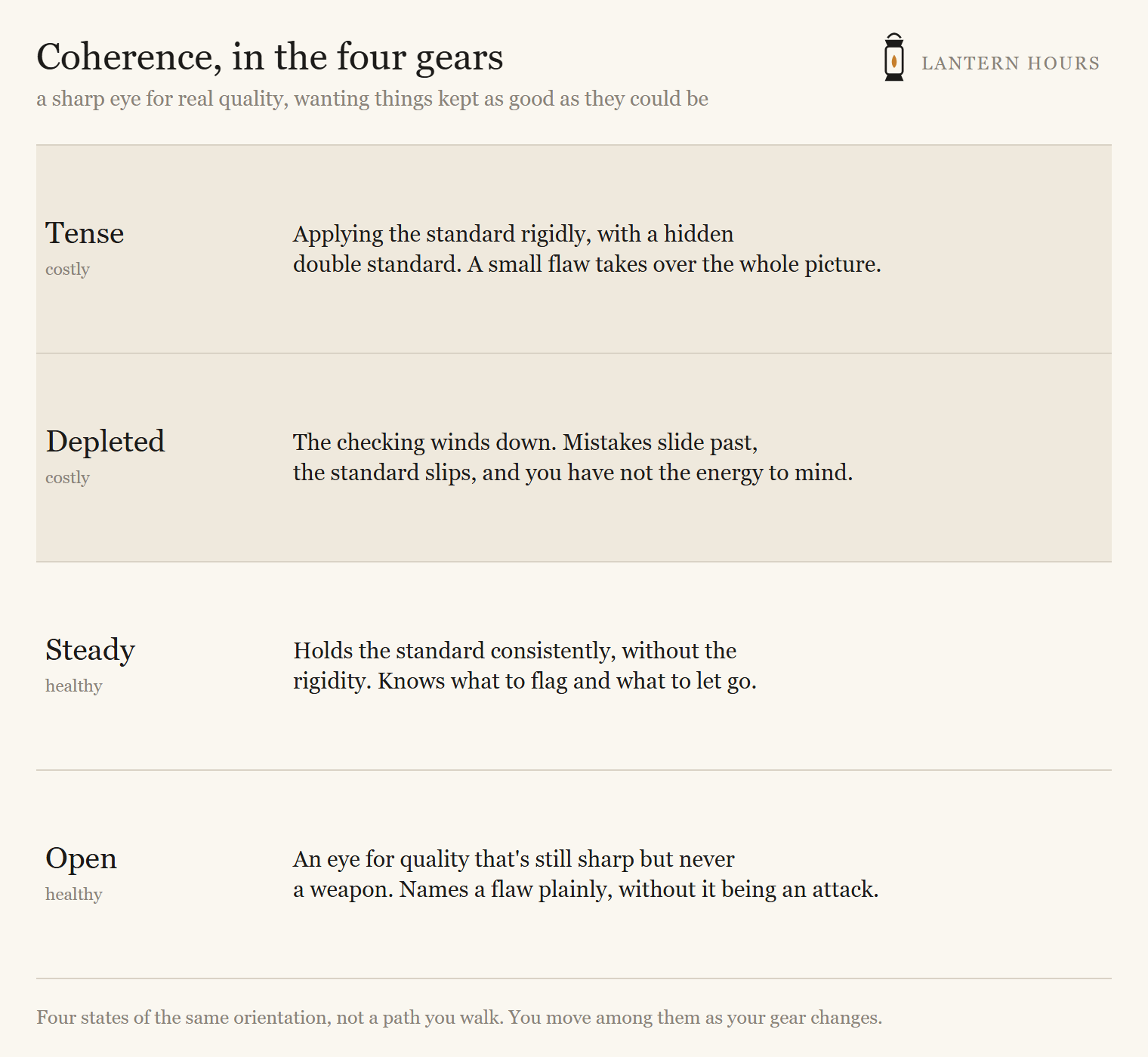
Coherence in the four gears: four states of one orientation, not a path you climb.
Tense: Coherence turned up too high
Tense is Coherence with the standard turned up too high, and no off position, no point where the checking ever switches off. You hold the rule rigidly and apply it to everything, with no give. There is no relief in the catching itself, no small win in being the one to put it right; the standard simply has to be met. But the moment you catch a place where something falls short, you cannot leave it alone until it is put right, and then the next not-quite-right thing is there, and that one cannot rest either. Nothing is ever quite good enough. The same rule you press hardest on everyone else’s work quietly lets your own off, and from the inside you cannot see it: the standard you hold others to is not the standard you actually keep. Underneath it is a fear that quality is quietly slipping and no one else can tell, so it falls to you to hold the line everywhere at once. Whether you feel okay rides on whether everything measures up.
What does a day in this gear feel like? You re-read the same email four times before you send it, certain there is still something off. You redo a piece of work that was basically fine, because basically fine is not the same as right. Things go out late, not because you were slow, but because you could not stop finding one more thing to fix. Nothing leaves your hands clean: there is always a join that could be tighter, a line that could be clearer, a number worth one more look.
Here is the sign: when you fix one thing, finishing it does not let you stop. Putting one thing right just shows you the next thing that is not right, and you pick the task back up. There is no point where you have done enough and can stand down. One catch only opens the next.
He proofread the wedding programme, caught the missing comma, fixed it, and reached to close the file. As the page redrew his eye landed on the spacing in the bride’s name, so he opened it back up and nudged the letters closer. He had just saved that when he saw the date was in the wrong font, and his hand went back to the mouse.
And holding the standard this hard is not a flaw in you. It is what a long, draining stretch does to a mind built to keep things right, and it eases as the stretch does.
That is the gear that burns out. When you cannot stop, eventually you run down, and you drop a gear.
Depleted: Coherence run down to empty
Depleted is Coherence run down to empty. After a long stretch of holding the line with no relief, the drive to keep things right has worn out, and the checking winds down. You let things through that you would once have caught. Mistakes slide past and you cannot make yourself care. It is not that you check coldly now; you have largely stopped, because the part of you that needed things to be right has gone quiet, and so has the energy. From outside it shows: the standard you were known for slips, and the people who rely on you can tell.
What does a day in this gear feel like? The work goes out with errors still in it, ones you would have caught in your sleep a year ago. You scan a page and your eye slides over the flaws without snagging. You know the standard has dropped, and you watch it drop from a distance, too flat to mind.
There are two signs. Against Tense: in Tense you cannot leave a single miss alone; in Depleted the misses go past you, and you have not the energy to mind. Against plain tiredness: a tired person rests and the care comes back; here the rest does not bring it back, and the standard you let slip stays slipped.
She handed back the essays barely marked, a tick here, a word there, where she would once have covered every margin in red. A student asked, carefully, whether she had had time to read his properly. She said of course she had. She had not, really, and what unsettled her was not the lie but that she could not bring herself to care that it was one.
If it has been months rather than weeks, and most of what used to move you has gone quiet, this gear is the least likely to lift on its own, and it is worth talking to someone trained to help. That is not a diagnosis. It is just the next sensible step, the same way you would see a doctor for a pain that would not go away. You would not call that weakness, and this is no different. This gear hides best from the person in it; if those around you keep noticing a flatness you cannot feel, let that count.
Steady: Coherence at a level you can hold
Steady is Coherence holding the standard at a cost you can keep paying. You still tell real quality from a near-miss. You still hold the line where it matters. But whether you feel okay no longer rides on everything measuring up, and you can let a small thing be good enough without it shaking you. You hold the standard where it counts, and you do not have to correct every miss. And the standard falls evenly now: you hold the same line for your own work that you hold for everyone else’s, where in Tense it had pressed hardest on others without your seeing it.
What does this feel like from the inside? You see the thing that is not quite right, fix it if it is worth fixing, and then you are done with it. You can hand the work over knowing it is good enough, even with a small flaw still in it, and not lie awake over the flaw. You still care that things are right, and you still catch what is wrong, but the caring sits at a level you can carry all week, instead of one that wrings you out by Tuesday.
Here is the sign, against Tense: you can stand down. You put the thing right, and then it is closed, and you let it go and move on. The checking has an off position. In Tense, finishing one thing only opens the next; in Steady, you handle it and it is actually done.
One important exception: a steady surface can quietly go hollow. There is a form of Steady that is not healthy, and it is the hardest state in this whole map to catch. Its name is Hollow Steady. From the outside it looks like dependable Coherence: you still check the work, still hold the line, still apply the standard exactly as you always have. What has drained away is the reason it ever mattered, the care underneath the rule. The standard runs on perfectly. The judgment and the conviction that gave it a point have gone quiet.
She graded the last essay, ticked the same three errors she always ticked, and wrote “see me” in the margin the way she had for years. The marking was as careful as ever, and no one would have found a thing wrong with it. She set the pen down and waited the half-second for the old sense that it mattered whether they got it right. It did not come, and she reached for the next essay anyway.
Do not mix this up with Depleted. In Depleted the checking winds down and it shows: the standard slips, errors get through, and the people who rely on you can tell. Hollow Steady is the opposite. You hold the standard flawlessly, so from the outside you look as exacting as ever, and no one, including you, is likely to notice the care underneath has gone. That invisibility is what makes it the most dangerous form on this map.
Hold this one lightly, because it is easy to get wrong: most people who worry that they have gone hollow have not. They are just tired or stretched thin. Here is the honest test. When something comes out genuinely right, after a real break, does the quiet satisfaction land? If it does, you were tired, not hollow. If getting it right keeps feeling like nothing no matter how much you rest, and it has gone on for months, that is worth an honest look from someone who knew you when it still mattered, and worth talking to someone trained to help.
He tightened the leaking joint, ran the tap, and watched the seal hold dry. Then he rolled the wrench back into its pouch, snapped the bag shut, and carried his tools out to the van without going back to run the tap one more time.
Open: Coherence still sharp, but no longer enforcing
Open is Coherence that keeps the eye for quality but is no longer run by it. You still hold the standard where it genuinely matters. You are also fine when a thing is just good enough, or when a standard does not need defending at all. Holding the line no longer compels you. The standard stays there, ready when it counts, never used as a weapon, and you do not need everything to measure up in order to feel okay. And that eye for quality is not just held in reserve: you put it to work on what you actually care about getting right, on building the thing so it truly holds together where it counts.
Here is what that looks like. You walk into a room and see, in one glance, the three things that are done badly, the way you always have. Then you get on with what you came to do, because none of the three is worth your afternoon. Later, on the one piece of work you do care about getting right, you give the standard everything: you check it, tighten it, and stay with it until it genuinely holds together. The eye never dimmed. You just stopped pointing it at everything.
One sign, against Steady, and the line here is soft, because Steady and Open shade into each other. Take a miss that does not matter: a small fault, a near-miss no one will be hurt by. Steady leans toward stepping in and putting it right, because that is what Steady does. Open tends to notice the very same miss, decide it does not matter here, and let it go.
The sharper line is against Depleted, because both Open and Depleted can let a thing slide, and they are not the same. Open lets the crooked picture go and still stops cold for a number in the accounts that does not add up, or a line in a contract that flatly contradicts another line three pages back. The standard is still live; it engages when something genuinely calls for it. Depleted lets the same things go because nothing reaches it, not the crooked frame and not the contract. The tell is not how calm you look; it is whether you can still be moved to act when it actually matters.
She saw the picture frame hanging crooked in her friend’s hallway, and her hand half lifted, the way it would have on any other wall. She let it drop, looked at the frame a moment longer, and carried the bottle of wine on into the kitchen with the frame still tilted behind her. An hour later, going over the accounts she had offered to check, a number in one column would not match the total. That one she did not let drop. She pulled the page closer, traced the line back, and stayed with it until the number came right.
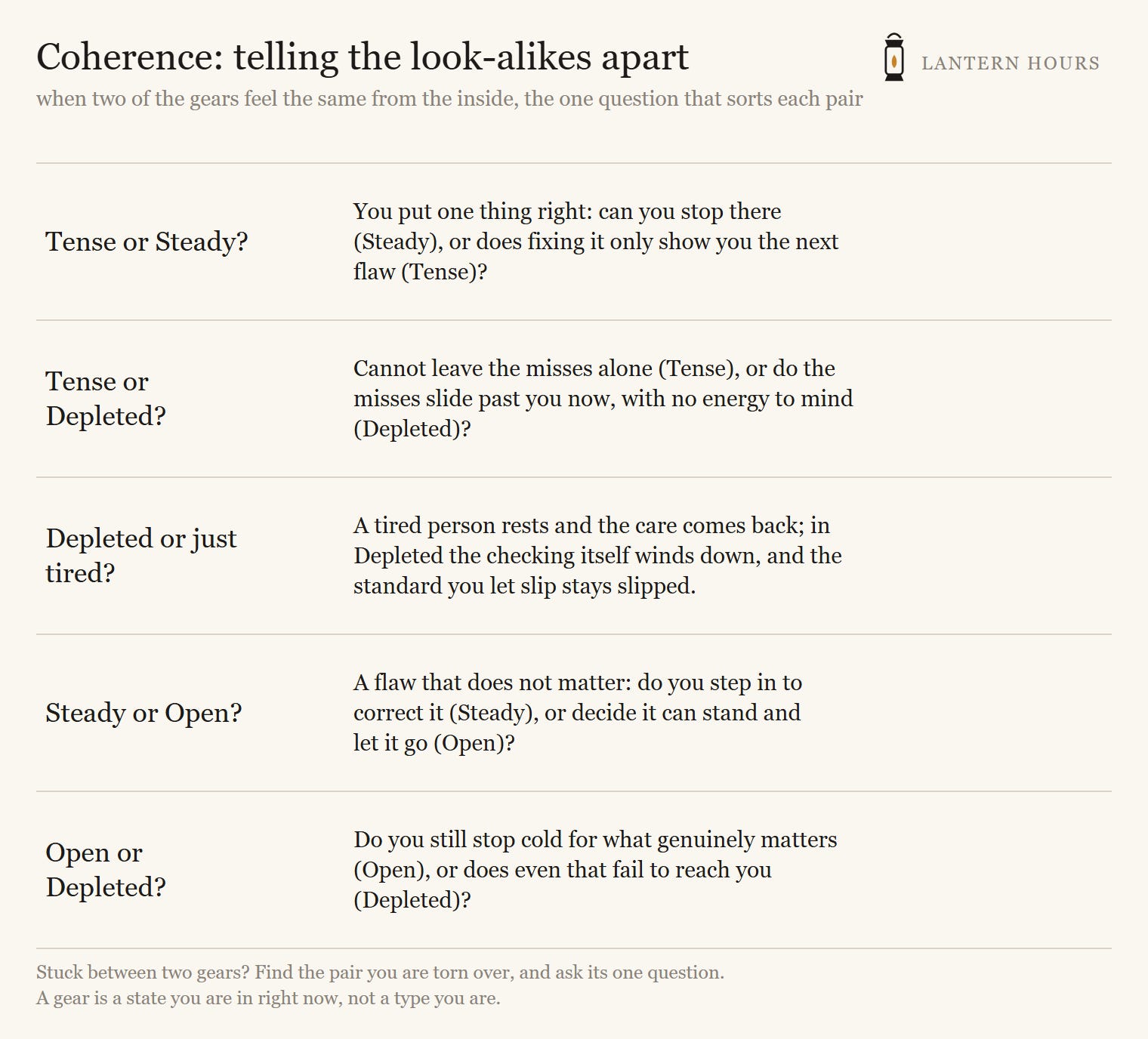
Telling the look-alikes apart: when two of the gears feel the same from the inside, the question that sorts them.
Coherence does not go away, and it is not meant to. You cannot quit your own orientation. The orientation is durable and slow to change; what moves, month to month, is the gear. You are not “a Coherence,” and you are not stuck in any gear. A costly gear is information about this stretch of your life, not a verdict on who you are. Notice which gear you are in. Remember it is not permanent. Check again in a month.
From here: the whole framework on one page, all in one place: the four gears, the five orientations, placing yourself, and the pairings people misread.
Or read another orientation: Comparison · Vigilance · Connection · Continuity.