
Comparison: When Someone Else's Good News Stings
The same eye for where you stand is what keeps you honest and sets the pace.

The email goes round mid-morning: someone he joined the company with on the same day has just been promoted past him. He types something warm into the thread, and means most of it. Underneath, fast and without his say-so, he is already measuring. How far ahead this puts her. How far behind it leaves him. He has done this since school, with classmates, with teammates, with strangers in a queue. If you asked him when he chose to start, he could not tell you. It does not feel like a choice. It feels like just how his mind works.
That habit of measuring has a name.
Two different things: who you are, and what gear you are in
This piece rests on one idea, and most of the confusion people feel about themselves comes from missing it. There are two separate things going on inside a person like the man above.
The first thing is your orientation: a long-term part of who you are, the part that stays much the same year after year. It is set early in life and slow to change. You do not pick it, and you cannot decide to swap it for another, any more than you can decide to find different things funny. In this framework there are five of these long-term parts, each one a different thing a person is most tuned to notice and care about.
This one is Comparison. When Comparison is your orientation, what you are most tuned to notice is where you stand next to other people. You measure. You watch who is ahead and who is behind, and you keep moving toward your next goal. This is not a flaw. At its best it is one of the most useful things about a person: it gets a great deal done, it keeps you honest about how you are really doing rather than how you wish you were, and people with this orientation often pull those around them up too, because they set a pace. Underneath it sits a quiet, specific fear: falling behind, or losing your independence and having to rely on others. That fear is what makes the measuring feel urgent, not the idle noticing you could put down.
The second thing is your gear. This is the part people most often get wrong. A gear is how hard or easy your orientation is working right now: how forced or how relaxed it feels this month. It is not a different you. It is the same orientation running hot in one stretch of your life and quiet in another. Which gear you are in is set by how much you are carrying, how well you are sleeping, how safe life feels right now, and how long the stretch has lasted. You do not pick it. You find yourself in one, the way you find yourself coming down with a cold. Your gear can change while your orientation stays exactly the same.
Think what that means in one person. A woman with the Comparison orientation might, in a calm year, measure herself against others in a relaxed, useful way, glancing at where she stands and getting on with her plan. Two years later, after a brutal stretch at work and not enough sleep, the same woman, with the same orientation, is checking those numbers twenty times a day and lying awake over them. She has not become a different person. Her orientation has not moved. What changed is her gear. This is why “Comparison” can never be the whole story about anyone. Right now you are running Comparison in one gear, and that gear is a state you are passing through, not a fixed fact about you.
One quick check first, because most people lead with more than one orientation and Comparison may or may not be one of yours. Think back to the last time someone you know did well: a friend who got the promotion, the old classmate with the new house. If part of you, fast and almost without deciding to, worked out what their good news meant for where you stand, then Comparison is one of yours, and the rest of this piece is for you. If their good news simply felt like good news, something in their life and not a measurement of yours, you probably lead with one of the other four, and would recognise yourself better there.
There are four gears, and they are not all the same
There are four gears your orientation can be in, and they are not equal. Two are healthy, Steady and Open: you can live in them for the long run without paying a price. The one thing to watch is that Steady has a hidden form, called Hollow Steady, that looks healthy but is not. We come to it in the Steady section. The other two, Tense and Depleted, cost you: stay in them long enough and they wear you down. Some gears are simply better to be in than others.
But being in a costly gear is not a verdict on you. It is not a grade, and it is not a flaw in your character. It is a state, set mostly by what your life has been like lately, and it can change. A costly gear tells you something true about this stretch of your life. It does not tell you who you are.
As you read the four, notice which one fits you right now, this month, not at your best and not at your worst.
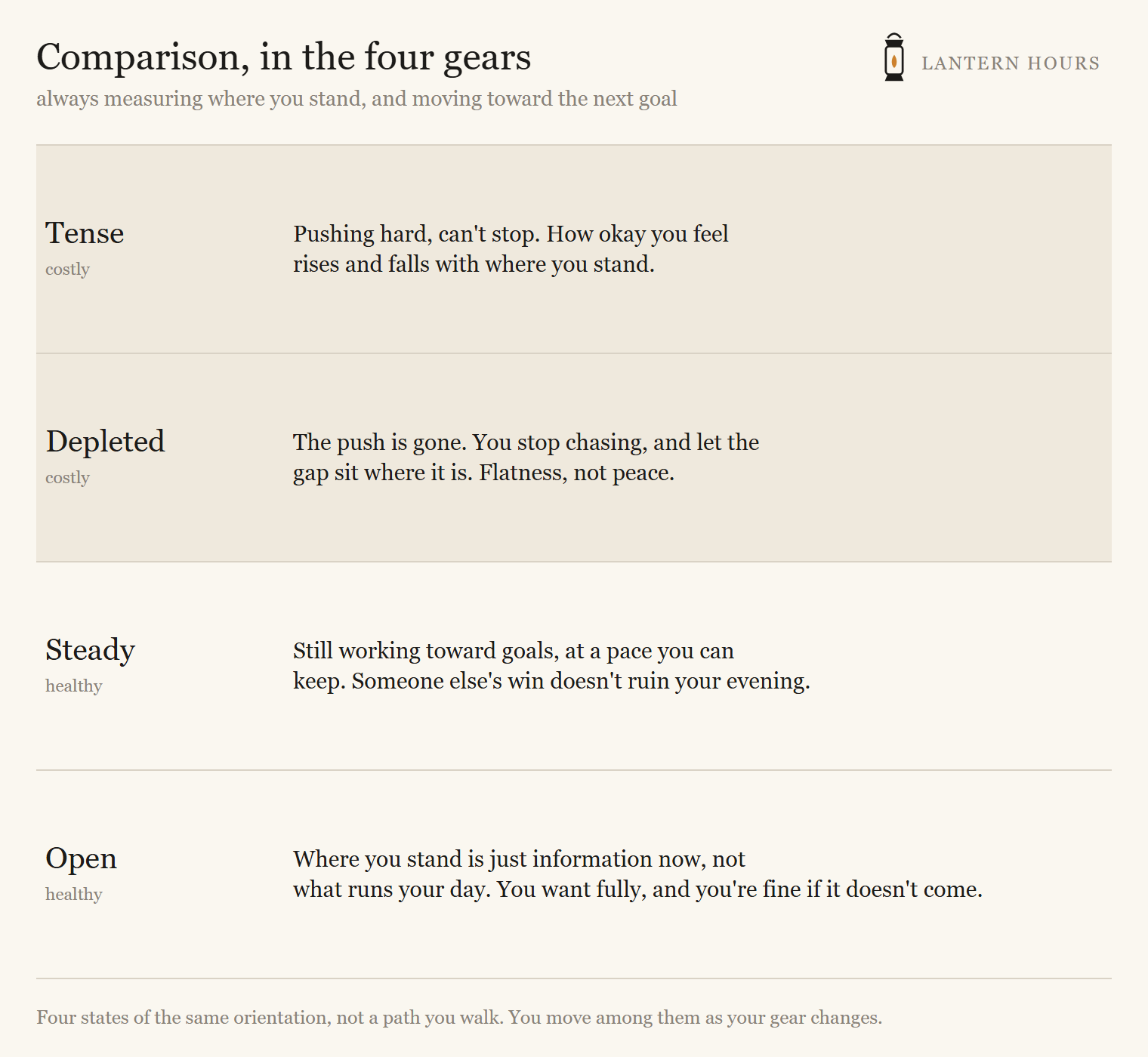
Comparison in the four gears: four states of one orientation, not a path you climb.
Tense: Comparison turned up too high
Tense is what Comparison looks like turned up too high and unable to come back down. You are on edge and cannot settle. You cannot stop pushing to get ahead, even past the point where it does any good. And the deepest sign of this gear is that how you feel about yourself, right now, today, rises and falls with how you measure up against other people.
What does a day in this gear feel like? You check your numbers again and again, sometimes one you already know has not moved. At night your mind runs the same loop: where you should be by your age, who started later and got further. Then a friend sends a photo of a house they have just bought. For a second you are happy for them. Then the happiness curdles into something about you. You are behind. You are slipping. The gap is widening, not closing.
Now the sign that tells this gear apart from ordinary drive, because from the inside the two feel almost identical. Plenty of people are ambitious and push hard and are fine. The sign of Tense is not that you compare. It is what the comparison does to you and how long it lasts. Someone else’s good news genuinely bothers you, and it does not pass in a moment; it sits with you for days, and you catch yourself returning to it. If good news about someone is something you notice and move past, you are not in this gear, however driven you are.
She told herself she would ease off once she reached the top quarter of her team. She got there on a Tuesday. By Thursday she was watching only one number: the score of the person ranked just above her.
And being in this gear is not a flaw in you. It is what a long, draining stretch does to a mind built to measure, and it eases as the stretch does.
One more thing, and it is the most important warning. Run this hot too long with no real break and you do not just stay tense forever. You burn out. Pushing this hard uses something up that does not refill while you keep pushing, and eventually it runs dry. You drop into the next gear down, Depleted, the empty one. That drop goes one way only: you cannot climb back by deciding to, the way you can ease off when you are merely tense. Once you have burned out, getting back is slow and not under your control. That is why Tense is not something to ride for years and feel proud of. It has an end, and the end is the empty gear.
Depleted: Comparison run down to empty
Depleted is what is left when Comparison has been run down to empty. The fear is still true of you. You are falling behind, and on some level you know it. But the wish to do anything about it is gone. You still measure where you stand; the measuring does not switch off. What has switched off is the part that used to make it lead anywhere. You notice the gap, and then nothing happens.
From the outside, a person in this gear just looks tired, which is why it is so easy to miss. Plenty of people are tired without being in this gear. So the thing to watch is not how tired someone seems, but the measuring and what it leads to. You still notice who got promoted, out of habit, but feel nothing. Someone passes you, the old reflex to measure starts up, then stops, with nothing after it. You go looking for the part of you that used to care, and cannot find it.
There are two signs here, doing two jobs. The first tells Depleted apart from Tense: the measuring still happens, but the urge to act on it has drained away. In Tense the measuring tortures and drives you; in Depleted it runs quietly in the background and goes nowhere. The second tells Depleted apart from plain tiredness: the measuring is still happening at all. If even that has gone silent, if you have stopped noticing where you stand and stopped caring in a way that touches everything, not just your ranking, then what you are dealing with may be larger than your gear, and the next paragraph is for you.
He used to stay late to close the gap on whoever was ahead of him. Now he sees the gap just as clearly and lets it sit. When a colleague asked if he was going for the senior role, he said maybe, and knew as he said it that he would not lift a finger toward it. What surprised him was how little he minded.
A few honest words about this gear, because it is the one that needs them. If this has been your state for months rather than weeks, and most of the things that used to interest you have gone flat and grey, it is the gear least likely to lift on its own just because you wait or try harder. It is worth talking to someone trained to help, a doctor or a therapist. That is not a diagnosis, and it is not me saying something is wrong with you. It is the same ordinary good sense that takes you to a doctor about a pain that will not go away. You would not call that weakness, and this is no different. One more thing, because it is the trap built into this gear: it is genuinely hard to see in yourself. The flatness that is the problem is also what stops you caring enough to notice it. So if people who know you well keep saying you seem switched off lately, do not wave it away. From the outside they can sometimes see this gear more clearly than you can.
Steady: Comparison at a pace you can keep up
Steady is Comparison running at a pace you can actually keep up, month after month, without it costing you. You still compare yourself to others; the orientation has not gone anywhere, and it is not supposed to. What has changed is that the result no longer decides how you feel about yourself. You can look, see where you stand, and not have your whole sense of your worth go up or down with the answer.
What does this feel like from the inside? You still want the next thing and are genuinely working toward it. The drive is real. But it runs at a pace you could hold for a long time, not a sprint that leaves you wrecked. You check where you stand because it is useful: it tells you what to do next. You are not checking because the answer is a verdict on you. When somebody faster comes past, you notice, then go back to your own plan, because their pace is theirs and yours is yours.
Here is how to tell this gear from the two costly ones, because it can be mistaken for both. Against Depleted: in Steady you still want to move, but the wanting is calm and warm rather than gone; in Depleted it is simply absent. Against Tense: in Steady, where you stand tells you what to do next; in Tense, it tells you what you are worth. But the clearest test of Steady is this: can you stop? In Steady you check, you adjust, and then you let it go and get on with your day. In Tense you cannot leave it alone; you told yourself you were done looking, and an hour later you are looking again. The ability to put it down is the heart of this gear.
One important exception: a steady surface can quietly go hollow. There is a form of Steady that is not healthy, and it is the hardest state in this whole map to catch. Its name is Hollow Steady. From the outside it looks like someone doing well: still driven, still hitting targets, still climbing. You keep chasing the next thing and you keep getting it. What has gone is the lift. The win that would once have carried you for a week now lands as nothing, and you reach for the next one anyway, on habit and the fear of stopping, not because you want it.
He got the promotion he had chased for three years. He read the email twice, waiting to feel the thing he had been working toward the whole time. Then he forwarded it to his team with a note about the paperwork and went to lunch. By the afternoon he was already eyeing the next rung, not because he wanted it, but because stopping was the one thing he did not know how to do.
Do not mix this up with Depleted. In Depleted the drive is gone and it shows: you stop pushing, you let the gap sit, and the people around you can see you have checked out. Hollow Steady is the opposite. You are still pushing, still winning, so from the outside you look like a high performer, and no one, including you, is likely to notice anything is wrong. That invisibility is what makes it the most dangerous form on this map.
Hold this one lightly, because it is easy to get wrong: most people who worry that they have gone hollow have not. They are just tired or stretched thin. Here is the honest test. When you actually win something you wanted, and then have a real break afterward, does the satisfaction land? If it does, you were tired, not hollow. If the wins keep coming and keep feeling like nothing, and it has gone on for months, that is worth an honest look from someone who knew you when winning still meant something, and worth talking to someone trained to help.
She wanted the senior role and said so, out loud, to her manager. Then she went home at six, because the role would still be there in a few months, and so would she.
Open: Comparison still sharp, but no longer steering
Open is the gear where reading rank is still switched fully on, and yet nothing about who you are depends on it. You still see where you stand, as clearly as ever. That seeing never turns off, because noticing where you stand is the whole point of Comparison. What has changed is what the seeing is for. It used to decide how you felt about yourself, and then who you were. Now it is just information: not your worth, not your sense of who you are, not an order to climb. What moves you is something you genuinely care about.
This is the gear people most often confuse with Steady. In Steady the drive to gain ground is switched on and you are managing it well; your worth no longer rides on the result, but you still want the next rung and are climbing toward it. Open is not better management of that. Steady is still organised around the climb; Open is not built around it at all, so the climb is now one thing you might do, not the thing you are for. The cleanest way to feel the difference is two people who both glance at a leaderboard and both look perfectly calm. The first sees she is in fourth, files it as useful, and goes back to her training plan, holding the small pull to climb in a grip she has practised. She is in Steady, and her calm is good management, because the pull is still there to manage. The second takes the leaderboard in just as clearly, sees her own place without blurring it, and goes straight back to a problem she finds fascinating, because the standing she just read asked nothing of her. She is in Open, and her calm is not management at all: there is nothing to manage, not because she failed to see the ranking but because seeing it no longer has any hold on her. Same calm face, same sharp eye. Completely different engine underneath.
One more sign keeps Open apart from Depleted, because “where I rank no longer runs me” can sound like “I no longer notice or care.” They are not the same. In Depleted the seeing itself has gone dull: you stop registering position because you have stopped registering most things, and nothing pulls you. In Open the seeing is fully alive, as sharp as ever, and something that truly matters still pulls you in. Feeling flat and past caring is Depleted. Seeing exactly where you stand, feeling no weight in it, and still being caught up in something you care about, that is Open.
Open is not a reward for becoming a better person, and not a place you reach and then stay. It is somewhere you pass through, sometimes for an afternoon, sometimes for a season. While you are in it, other people stop being positions on your ladder and read simply as people, getting on with lives of their own. Then a hard week comes, the grip tightens again, and you are somewhere else. That is fine too. None of this is a ladder you climb. It is a gear you are in.
He saw a former student’s name on a list of award winners that he was not on. He registered it at once, exactly where he stood next to them, the way he always had. The old urge to make it mean something about himself flickered up, he noticed it, and he went back to the chapter he was enjoying writing.
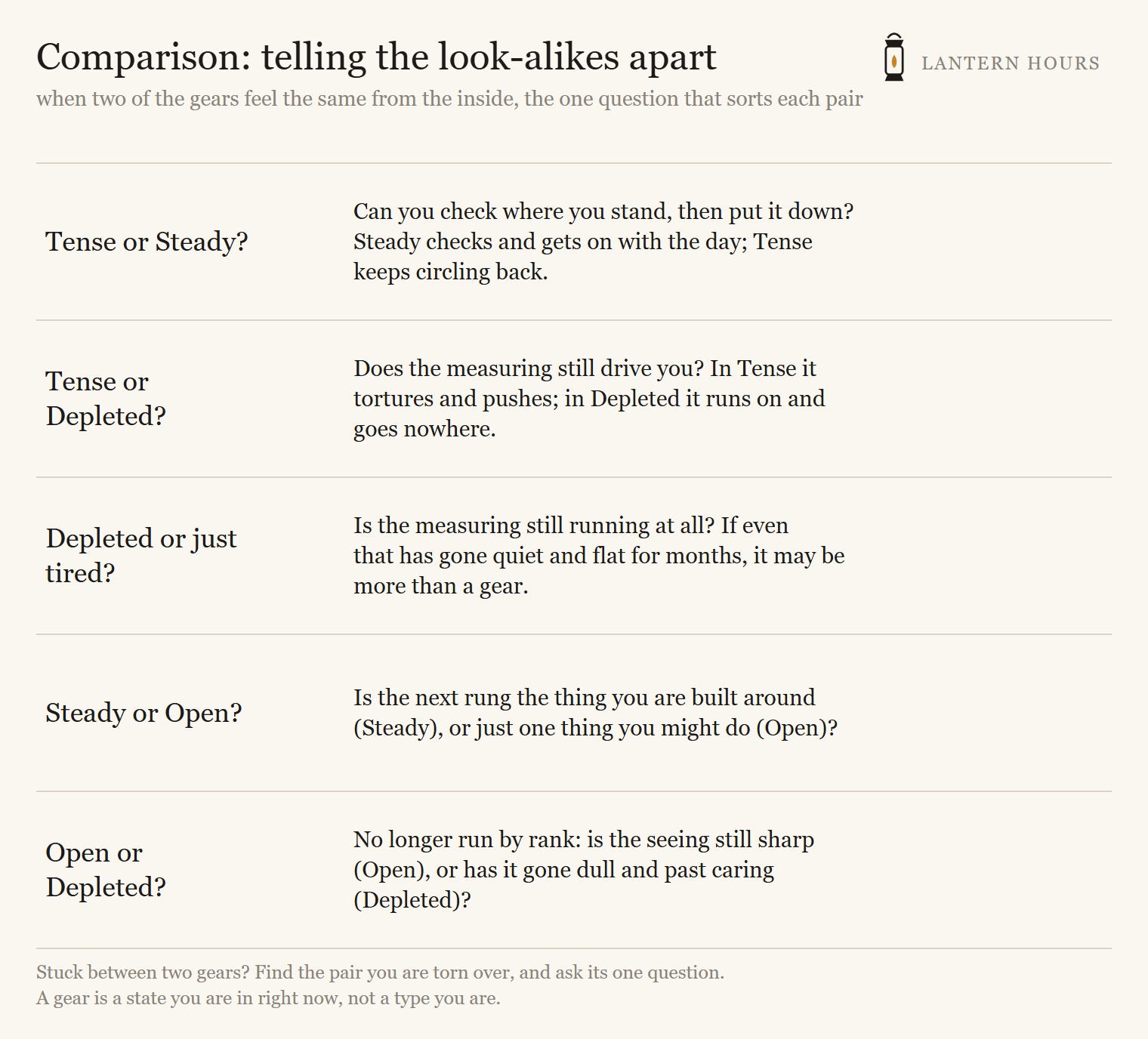
Telling the look-alikes apart: when two of the gears feel the same from the inside, the question that sorts them.
Comparison does not go away, and it is not meant to. You cannot get rid of your own orientation, and you would not want to: it is part of how you are built, and in a healthy gear it is one of the best things about you. So nothing here asks you to stop comparing, or to become someone else. What changes is the gear, not the orientation.
That is the point to carry away. You are not “a Comparison,” as though that were a fixed type stamped on you. And you are not trapped in Tense or Depleted, even if that is where you are today. If one of the four gears felt most like you, that is simply the gear you are in right now, in this stretch of your life, and gears change, even though Depleted lifts more slowly than the rest and is the one most worth getting help with. A costly gear is telling you something true about this stretch. It is not telling you who you are or who you will always be. So do three small things. Notice which gear you are in. Remember it is not permanent. And check again in a month, because by then it may already have moved.
From here: the whole framework on one page, all in one place: the four gears, the five orientations, placing yourself, and the pairings people misread.
Or read another orientation: Vigilance · Connection · Continuity · Coherence.