
Connection: When a Short Reply Can Sink Your Whole Day
The same care that reads a short reply so closely is what makes people feel truly understood.

The kids’ party is at its peak, all noise and cake, and she is working the edges of the room. The dad standing alone by the door, not knowing anyone: she has already crossed over once to bring him in. The friend who went flat and quiet on the sofa: she is heading there next. She is not doing it to manage anyone. She feels the small gaps open up between people and she cannot let them sit. She is tired and her feet hurt, and she will cross the room one more time before she leaves. She never decided to be this way. She always has been.
That crossing the room toward people is part of how some people are built. Your orientation is the main way your mind works, the part of you that stays the same as you grow up. There are five of these. This one is Connection: you are turned toward closeness with other people. You keep tuning into how they feel, so you and they stay genuinely in touch. At its best, it makes people feel genuinely understood without having to explain themselves first. The understanding runs both ways: you are met as much as you meet them. It builds real closeness and trust.
Your orientation is durable: it stays the same underneath as you grow up, and it stays put through whatever gear you are in. What changes is the gear. A gear is how hard or easy your orientation is working right now: how forced or how relaxed it feels this month. It is not a different you. It is the same orientation running hot in one stretch of your life and quiet in another. Which gear you are in is set by how much you are carrying, how well you are sleeping, how safe life feels right now, and how long the stretch has lasted. You do not pick it. You find yourself in one, the way you find yourself coming down with a cold. So Connection is never simply who you are.
Watch how this plays out in a single life. A woman whose orientation is Connection might, in a calm year, sense a friend is a little low, send a warm message, feel the ease come back between them, and let it rest there. Two years later, after a long stretch of strain and too little sleep, the same woman, with the same orientation, cannot let a silence be: she reads a short reply as a sign she has done something wrong, checks in twice more than she needs to, and lies awake wondering whether someone is quietly upset with her. She has not become a different person. Her orientation has not moved. What changed is her gear. This is why “Connection” can never be the whole story about anyone. Right now you are running Connection in one gear, and that gear is a state you are passing through, not a fixed fact about you.
Think of one real moment in the last week when someone near you seemed a little off. A friend, a coworker, a person across the room. Did the first thing you did go to them, reading how they felt, wanting to make it right? Then this is probably you. If instead you wanted to know what had gone wrong, or whether someone had been unfair, that is a different orientation. Connection goes to the person first. There is one near cousin to rule out, because from the outside it looks almost the same. Someone with the Continuity orientation also steps in when a friend goes quiet.
Here is the clearest way to tell the two apart. Picture two people who both notice the same thing: a close friend has gone quiet for a couple of weeks, and both of them reach out. The first one is reaching for the friend. What they want is to feel back in touch, warm and easy together again, the way it was before. The moment that warmth comes back, they are settled. That is Connection. The second one is reaching for the friendship itself. What they want is to know it still holds, that nothing has quietly slipped and the bond is intact. The moment they know it is solid, they are settled, even if the warm feeling takes longer to come back. That is Continuity. Same quiet friend, same reaching out. The only difference is what settles you: being back in touch, or knowing nothing was lost.
There is one clean way to tell. When a rough patch with someone is finally smoothed over, does the relief come from feeling close to them again, warm and met? If it does, this is you, and what you are after is the closeness itself, felt now. If instead the relief is mostly that the bond held and nothing slipped, that points to Continuity, the near cousin.
There are four gears your orientation can be in, and they are not equal. Two are healthy, Steady and Open: you can live in them for the long run without paying a price. The one thing to watch is that Steady has a hidden form, called Hollow Steady, that looks healthy but is not. We come to it in the Steady section. The other two, Tense and Depleted, cost you: stay in them long enough and they wear you down. Some gears are simply better to be in than others.
But being in a costly gear is not a verdict on you. It is not a grade, and it is not a flaw in your character. It is a state, set mostly by what your life has been like lately, and it can change. A costly gear tells you something true about this stretch of your life. It does not tell you who you are.
As you read the four, notice which one fits you right now, this month, not at your best and not at your worst.
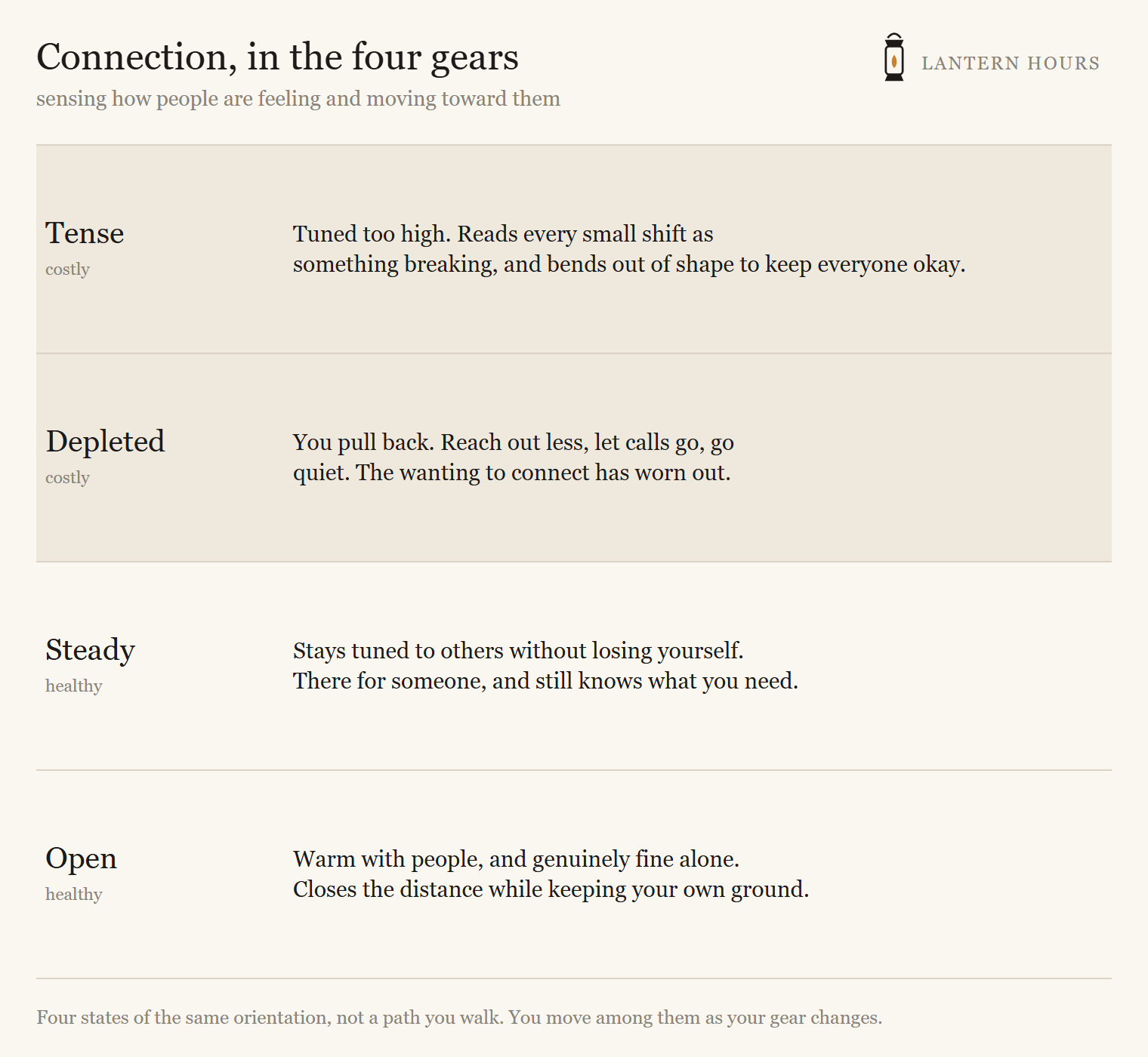
Connection in the four gears: four states of one orientation, not a path you climb.
Tense: Connection turned up too high
Tense is Connection running too high. You are checking how everyone is, but now you cannot stop. You scan every face for the smallest sign that someone is upset, and the moment you catch one, you have to fix it. You give in to keep the peace. You give too much, smooth things over, go along with what others want, and lose track of what you need. Whether you are okay rides on everyone around you being okay with you.
There is a particular trap in this gear. The quieter and more distant the other person goes, the more alarmed you get. A short reply, a long pause, a partner who is simply tired and content to say nothing reads to you as a sign that something has gone wrong between you. So you move toward them harder: you ask if they are okay, you check, you try to close a gap that may live only in your own alarm. The calmer they get, the more you chase. A settled person beside you can feel less like company and more like a warning.
Here is the sign. The ordinary version of Connection reads the room and then lets it rest. Tense cannot let it rest. You smooth one thing over, and instead of feeling settled, you are already watching for the next sign of trouble. You say yes to a thing you did not want, because saying no might leave someone unhappy with you. The checking never switches off.
A friend texted “k.” Just the one letter. She read it on the bus and felt her stomach drop, and by her stop she had typed and deleted three replies trying to find the one that would put it right. She had hosted the last three dinners and was worn out, but that night she offered to host again, because the offer would smooth it over, and she could not sit with that friend being even a little cool toward her.
And running this hot is not a flaw in you. It is what a long, anxious stretch does to a mind built to stay close, and it eases as life steadies.
Tense run too long burns down. The same hot gear, held with no let-up, runs down into the empty one below. It is a burn-down, not a downshift you choose, and you do not get back up by deciding to.
Depleted: Connection run down to empty
Depleted is Connection run down to empty. This is the gear you fall into after a long stretch of caring hard with too little coming back: the drive to connect has worn out. So you pull back. You reach out less, let messages sit, and quietly drop the plans you would once have moved mountains to keep. It is not that a warm surface is hiding the emptiness. The wanting itself has gone, and the energy that used to carry you toward people has gone with it. You are not on edge any more. You have just gone quiet and a little distant, and the people close to you can usually tell.
What does a day in this gear feel like? The phone buzzes, you see who it is, and you decide without much feeling to answer later, and later never comes. A friend asks if you want to meet and you say you are swamped, because the thought of it just lands as heavy. You are not angry with anyone. You have pulled the blanket over, let the threads you used to tend go slack, and the part of you that would once have minded is too worn out to mind.
There are two signs. Against Tense: Tense is frantic, still scanning every face, still trying to fix how everyone feels. Depleted has stopped reaching out at all, because the energy to mind is simply gone. Against plain tiredness: a tired person who is not built this way was never the one holding everyone together in the first place. You were. So going quiet and pulling away is a real change in you, not just a hard week.
Her sister’s name lit up the screen, the third missed call that week. She watched it ring from across the room, told herself she would call back tomorrow, and already knew she would not. A year ago she would have picked up before the second ring.
From the inside this gear can just feel like coping, so you may not name it yourself, but it tends to show: the people who know you notice you have gone quiet or dropped off, and what they see is worth taking seriously. It is also the easiest gear to get stuck in. If it has been months rather than weeks, and most of what used to move you has gone quiet, this is the gear least likely to get better on its own. You do not get back out of it by deciding to; coming back runs over weeks and months, on rest and support, not on willpower. And it is worth talking to someone trained to help. That is not a diagnosis. It is just the next sensible step, the same way you would see a doctor for a pain that would not go away.
Steady: Connection at a level you can hold
Steady is Connection at a level you can hold, month after month. You are still warm and tuned into people, still checking how everyone is, but at a pace they can keep and you can keep. You read how someone feels and you care, and your sense of who you are no longer dissolves into their mood. When someone near you is upset, you can be there for them without it deciding whether you are okay.
What does this feel like from the inside? You notice a friend is having a hard week, you call, you listen, you help where you can, and then you go home and your evening is your own. You can let a message sit until morning without a knot in your stomach about it. You still feel people, and you still move toward them, but their mood is no longer the thing your own day rises and falls on.
Here is the sign. The clearest test is whether you can stand down. In Tense, the checking never switches off, and settling one worry only opens the next. In Steady, you check how someone is, you do what is needed, and then you actually let it go. You can sit with a friend who is having a hard day, do what helps, and go home without carrying it all night.
One important exception: a steady surface can quietly go hollow. There is a form of Steady that is not healthy, and it is the hardest state in this whole map to catch. Its name is Hollow Steady. From the outside, and often from the inside too, it looks exactly like real Steady. You still check how everyone is, still show up, still do all the warm things you have always done. What has changed is that the warmth that used to come with it has quietly drained away. The actions stay the same. The feeling behind them is gone.
At her friend’s birthday dinner she was the warm one again, remembering the small details, asking the right questions, making everyone feel looked after. Her friend hugged her goodbye and said she did not know what she would do without her. No one at that table could have guessed that inside she had felt none of it, that she had run the whole evening on the memory of how it used to feel.
Do not mix this up with Depleted. In Depleted the running-down shows: you look flat or tired, and the people close to you can usually tell something is off. Hollow Steady is the opposite. The surface is flawless, so no one around you notices, and most of the time you do not either. That invisibility is exactly what makes it the most dangerous form on this map.
Hold this one lightly, because it is easy to get wrong: most people who worry that they have gone hollow have not. They are just tired or stretched thin. Here is the honest test. When the pressure truly lifts, on a real break or a quiet hour to yourself, does the warmth come back? If it does, you were tired, not hollow. If the quiet moment comes and there is still nothing there, and it has gone on for months, that is worth an honest look from someone who knew you when the warmth was there, and worth talking to someone trained to help.
A coworker caught her at the lift, close to tears about a review that had gone badly. She walked him to the coffee machine, listened the whole way down, and helped him sort out what he would actually say to his manager. Then she went back to her desk and finished her own report. On the drive home she thought about dinner, not about him.
Open: Connection still warm, but no longer pulled to everyone
Open is Connection that still works but no longer runs you. You read people clearly and connect deeply when you are with them, the same as ever. Now that warmth goes to the people you are actually with and the ones who matter most to you, instead of running the whole time as a need to keep everyone okay. You are also completely fine on your own. Closeness no longer pulls at you the way it did. You do not need everyone around you to be okay in order to be okay yourself.
Here is what that looks like. You walk into a gathering and read the room in a glance, the way you always have: who is easy, who is a little off, who is alone at the edge. You go and talk to the people you actually want to talk to, and you have a real conversation. The person at the edge who seems content to be there, you leave be. You go home when you are ready, not when the last worry is settled, because there is no last worry pulling at you.
Here is the sign, against Steady. But the line here is soft, because Steady and Open shade into each other, so treat what follows as a rough guide, not a hard rule. Steady and Open part ways over what each does when someone is a little upset but does not really need them. Steady still steps in and tends to it, because it is there and that is what Connection does. Open notices the very same thing, tends to the part that genuinely matters, and lets the rest be. Open is also at peace when apart. You can leave a small thing alone, and you can spend a day by yourself, and neither one leaves you uneasy.
One thing to check, because this gear is easy to confuse with the empty one: Open can still fully step in when something genuinely calls you. Flat and past caring is Depleted; able to step in when it counts is Open. And for Connection there is a catch: the calm, settled feeling of Open can sometimes be the empty gear wearing a calm face. So checking on your own will not always tell the two apart. If you are unsure, the surer signs are warmth still in your eyes when you are with people, and the wish to reach out and make things right coming back on its own. An outside view helps here too.
Her neighbour gave a short answer at the gate and seemed a little flat. She noticed it, said it was good to see him, and carried her bags inside. He was having an ordinary off morning and did not need anything from her, so she let it be. That evening she sat alone with a book and a cup of tea, the house quiet, and did not once go down the list of people she knew to check that each of them was fine.
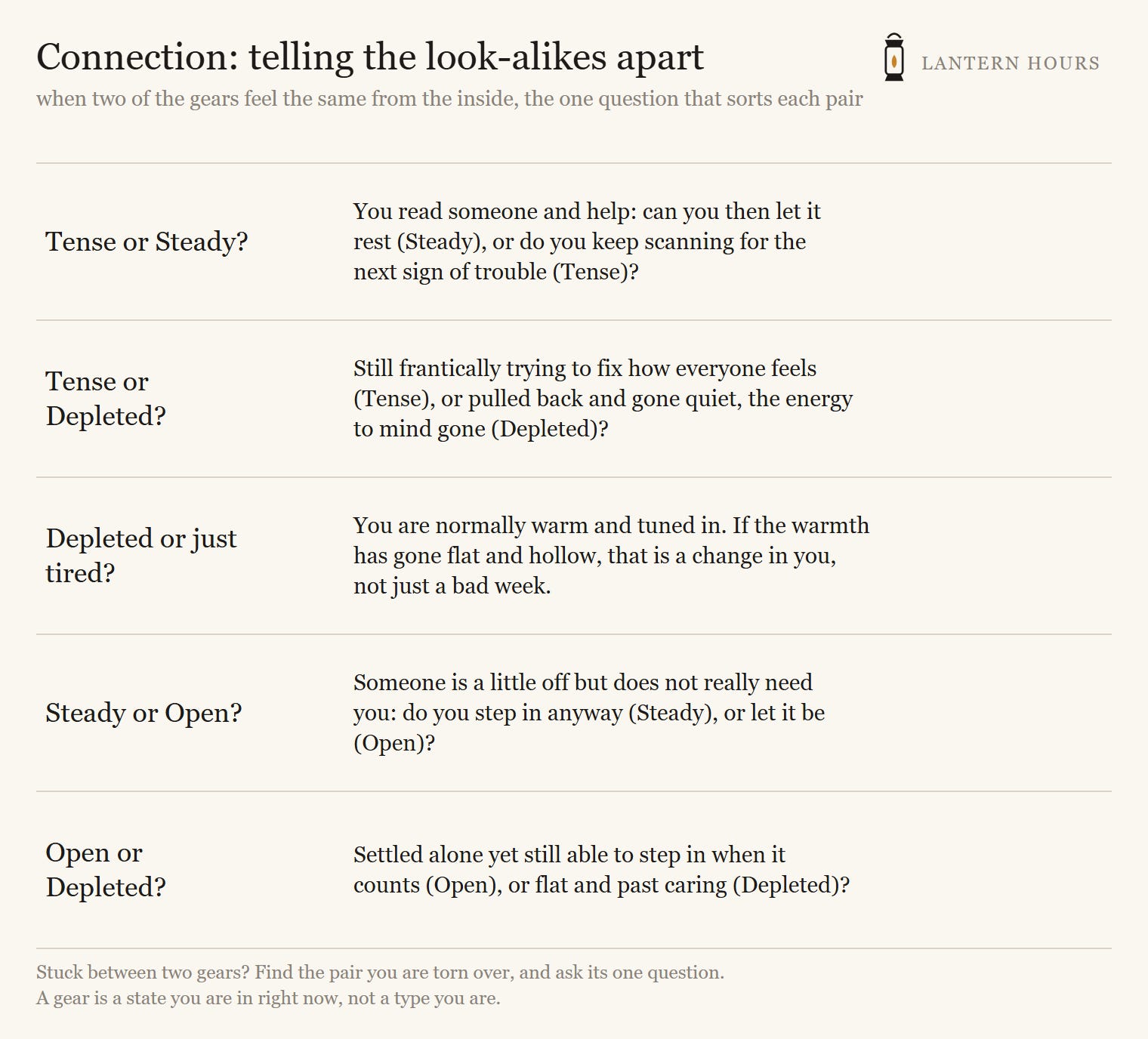
Telling the look-alikes apart: when two of the gears feel the same from the inside, the question that sorts them.
Connection does not go away, and it is not meant to. You do not get to swap your orientation out the way you change a mood; it is the durable part. What changes is the gear. You are not “a Connection,” and you are not stuck in whatever gear you are in now. A costly gear is information about this stretch of your life, not a verdict on who you are. Notice which gear you are in. Remember it is not permanent. Then check again in a month.
From here: the whole framework on one page, all in one place: the four gears, the five orientations, placing yourself, and the pairings people misread.
Or read another orientation: Comparison · Vigilance · Continuity · Coherence.