
Continuity: When You Can't Let Anything Slip
The same hold that wears you out is what everyone else leans on.

She is up before the rest of the house, the way she is every morning. She runs her eye down the day for who needs what, writes the note so the bins go out, moves yesterday’s washing on, sets out the bowls for a breakfast nobody has asked for yet. Nobody asked her to do any of it. If she does not stay ahead of it, something starts to slip. She never sat down one day and decided to be the person who keeps things going. She just is.
That habit of keeping things going is part of how some people are built. Your orientation is the main way your mind works, the part of you that stays the same as you grow up. There are five of these. This one is Continuity: you keep things going, the routines and the commitments and the people you have looked after, and you hold onto what lasts. At its best, you are the steady ground other people lean on, the one whose follow-through they can count on.
Your orientation is the lasting pull underneath: it does not flip from month to month the way the gear does. What changes is the gear it is running in. A gear is how hard or easy your orientation is working right now: how forced or how relaxed it feels this month. It is not a different you. It is the same orientation running hot in one stretch of your life and quiet in another. Which gear you are in is set by how much you are carrying, how well you are sleeping, how safe life feels right now, and how long the stretch has lasted. You do not pick it. You find yourself in one, the way you find yourself coming down with a cold. So keeping things going is never simply who you are.
See what this looks like over time. A man whose orientation is Continuity might, in a calm year, keep the household running, look after the people who depend on him, and let an old plan quietly change when it needs to, without much fuss. Two years later, after a long stretch of strain and too little sleep, the same man, with the same orientation, cannot let anything change or lapse: he grips every routine, dreads any sign that something is slipping, and lies awake over a small thing that came loose. He has not become a different person. His orientation has not moved. What changed is his gear. This is why “Continuity” can never be the whole story about anyone. Right now you are running Continuity in one gear, and that gear is a state you are passing through, not a fixed fact about you.
Here is one way to check. Think of a recent moment when something you relied on looked like it might fall apart: a habit you had let slide, a friend you had not called in too long, a system at work that was starting to break down. Was your first move to step in and hold it together, to put it back the way it was before it could be lost? If yes, this is probably you. If instead you reached to change it into something new, or to win an argument about it, or to scan it for what was wrong, that points to a different orientation.
There is one near cousin to rule out, because from the outside it looks almost the same. Someone with the Connection orientation also steps in when a friend goes quiet.
Here is the clearest way to tell the two apart. Picture two people who both notice the same thing: a close friend has gone quiet for a couple of weeks, and both of them reach out. The first one is reaching for the friend. What they want is to feel back in touch, warm and easy together again, the way it was before. The moment that warmth comes back, they are settled. That is Connection. The second one is reaching for the friendship itself. What they want is to know it still holds, that nothing has quietly slipped and the bond is intact. The moment they know it is solid, they are settled, even if the warm feeling takes longer to come back. That is Continuity. Same quiet friend, same reaching out. The only difference is what settles you: being back in touch, or knowing nothing was lost.
The quickest check is this. When something you count on wobbles and is then sorted out, does the relief come from knowing it held and nothing was lost? If it does, this is you. If instead the relief is mostly about feeling close to the person again, that points to Connection, the near cousin.
There are four gears your orientation can be in, and they are not equal. Two are healthy, Steady and Open: you can live in them for the long run without paying a price. The one thing to watch is that Steady has a hidden form, called Hollow Steady, that looks healthy but is not. We come to it in the Steady section. The other two, Tense and Depleted, cost you: stay in them long enough and they wear you down. Some gears are simply better to be in than others.
But being in a costly gear is not a verdict on you. It is not a grade, and it is not a flaw in your character. It is a state, set mostly by what your life has been like lately, and it can change. A costly gear tells you something true about this stretch of your life. It does not tell you who you are.
As you read the four, notice which one fits you right now, this month, not at your best and not at your worst.
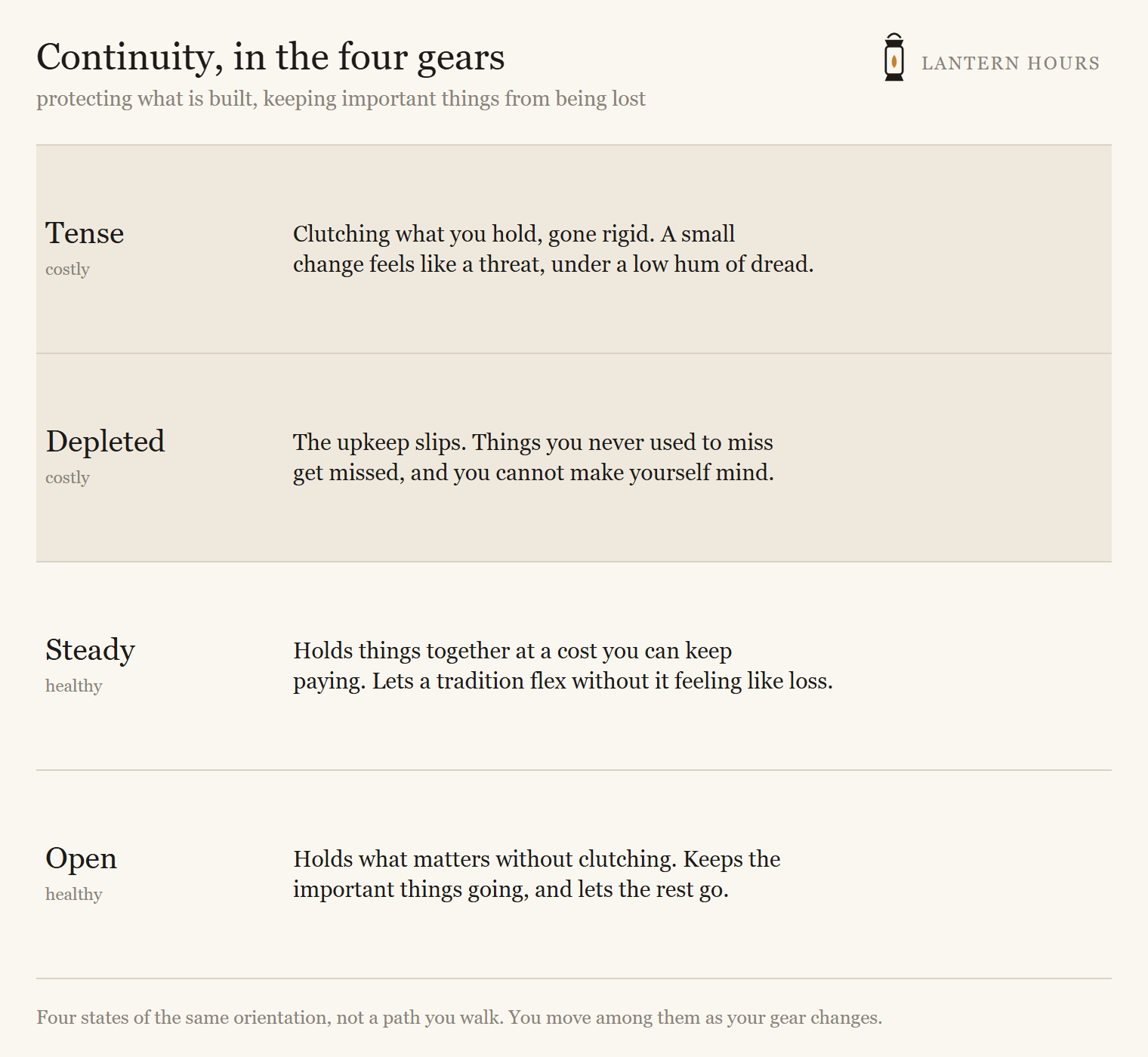
Continuity in the four gears: four states of one orientation, not a path you climb.
Tense: keeping things going, turned up too high
Tense is Continuity running too high. You hold on too tight, and you cannot let anything change or be lost, even when the change would be good. You watch all the time for any sign that something is wearing out or about to slip away, and the moment you catch one you have to fix it right then. Underneath is the fear that the whole reliable structure of your life is about to come apart. You feel you are only okay as long as nothing is lost and everything stays in its place.
What does a day in this gear feel like? You check the locks twice, then go back and check them a third time. You cannot let a friendship lapse without a flicker of dread, so you keep up every thread and every standing arrangement, long past the point it costs you more than it gives. A change at work that might be fine, or even good, lands as a threat, and you brace against it. Nothing is ever safely handled: there is always one more thing that could slip if you stop holding it.
Here is the sign. The watching never switches off. In the ordinary version of keeping things going, you do the upkeep and then you let it rest. In Tense there is no rest: you handle one thing and it only shows you the next thing, and you cannot stand down. Catching one loose thread does not settle you. It opens the next one.
He tightened the loose cabinet hinge his wife had mentioned, set the screwdriver down, and on his way out of the kitchen his eyes went straight to the tap, which had started to drip again, and to the chair with the wobble he had been meaning to glue, so he picked the screwdriver back up.
And gripping this hard is not a flaw in you. It is what a long, unsafe stretch does to a mind built to keep things going, and it eases as the ground feels firm again.
It cannot stay there. Running that high burns out, and when it does you drop a gear.
Depleted: keeping things going, run down to empty
Depleted is Continuity run down to empty. After a long stretch of holding everything together with no let-up, the drive to keep things going has worn out, and the upkeep starts to slip. The bills sit unopened. The routines you never used to miss get missed. You are not bracing against loss any more; you have stopped holding on at all, because you no longer have the energy to. Often there is a low grief or numbness underneath: a sense that you are letting go of something and cannot make yourself mind. From the outside it shows: things around you fall out of order, and the people who know you can tell you have let go of the wheel.
What does a day in this gear feel like? The small maintenance that used to be automatic stops happening. You mean to deal with the letter, the leak, the call, and you just do not. The standing dates lapse. It is not that you do the upkeep coldly now; you have largely stopped, and a low grey flatness has settled where the drive used to be.
There are two signs. Against Tense: in Tense you grip everything, frantic that something will slip; in Depleted you have stopped gripping, and things do slip, and you watch them go without the energy to catch them. Against plain tiredness: a tired person rests and the drive to look after things comes back; here it does not, and what you let go stays let go.
The shop used to be locked, counted, and wiped down by half past six every night without fail. Lately he leaves the till till morning, and last week he forgot the back door twice. A regular asked if everything was alright with the place. He said it was fine. He was not sure it was.
If this has gone on for months rather than weeks, and most of what used to move you has gone quiet, this is the gear least likely to lift on its own, and it is worth talking to someone trained to help. That is not a diagnosis. It is just the next sensible step, the same way you would see a doctor for a pain that would not go away. And because this gear is so easy to miss from the inside, the people who know you may see it before you do; if they keep saying you seem off, take that seriously.
Steady: keeping things going, at a level you can hold
Steady is Continuity at a level you can hold. You really do keep things going and you look after what lasts, but at a cost you can keep paying, month after month, without running yourself down. The difference is that your sense of who you are no longer rides on nothing ever changing or being lost. You can let some things change. You can let some things go, and it does not shake you.
What does this feel like from the inside? You keep what is worth keeping, and you let the rest move. You do the upkeep that matters, and when something reaches its end, you let it end without bracing against it. You can come back from a week away to a few things out of place and simply set them right, instead of feeling that the ground shifted while you were gone. You hold what you hold because it is worth holding, not because letting any of it go would undo you.
One important exception: a steady surface can quietly go hollow. There is a form of Steady that is not healthy, and it is the hardest state in this whole map to catch. Its name is Hollow Steady. From the outside it looks like dependable Continuity: you still hold everything together, still do the upkeep, still show up as the reliable one, exactly as you always have. What has drained away is the sense that any of it matters, that what you are keeping is connected to anything worth keeping. The keeping runs on perfectly. The point of it has gone quiet.
He locked the shop the way he had every night for eleven years: counted the cash, wiped the counter, set the alarm. Everything was in order, the way he had always kept it. He stood with his hand on the light switch and waited for the small squared-away feeling that used to close the day, the sense that what he looked after was safe. It did not come. He turned off the light and went home, and the shop was perfect, and he felt nothing about it.
One sign of this is easy to miss. You can describe your whole day by what you kept running: what you maintained, who you looked after, what you held in place. But if someone asks what you yourself wanted out of any of it, you go quiet, as if there were nothing under the keeping to answer.
Do not mix this up with Depleted. In Depleted the holding-on winds down and it shows: the upkeep slips, things fall out of order, and the people around you can see you have let go. Hollow Steady is the opposite. You keep everything running flawlessly, so from the outside you look as reliable as ever, and no one, including you, is likely to notice the meaning underneath has gone. That invisibility is what makes it the most dangerous form on this map.
Hold this one lightly, because it is easy to get wrong: most people who worry that they have gone hollow have not. They are just tired or stretched thin. Here is the honest test. When the pressure truly lifts, on a real break with nothing to maintain, does the quiet satisfaction in what you keep come back? If it does, you were tired, not hollow. If the keeping goes on meaning nothing no matter how much rest you get, and it has gone on for months, that is worth an honest look from someone who knew you when it still meant something, and worth talking to someone trained to help.
There is also a separate, quiet, inward pattern, where you hold back and turn things over until you understand them. From the outside it can look like Steady, but underneath it is its own pattern, not a kind of Steady. If that fits you better, it is worth knowing about on its own.
Here is the sign, against Tense. Ask whether you can stand down. In Tense the watching has no off position. In Steady it does: you handle the thing that needs handling, and then you actually let it go and rest. You are not waiting for the next loose thread. When it comes you will deal with it, and until then you are off duty.
When the rain found a way into the spare room, she spent Saturday morning up the ladder sealing the gap and laying out a bucket in case, and once it was dry she came down, washed her hands, and spent the rest of the day reading in the next room without once going back to put her hand on the ceiling.
Open: keeping things going, no longer clutching
Open is Continuity that still works but no longer runs on holding. You still notice the moment something starts to slip, as keenly as ever; that watch never switches off, because noticing what is at risk is the whole of Continuity. What has changed is that noticing no longer makes you grab it and hold on. Keeping things going used to be the pull under everything you did; now it is just one thing you sometimes choose, not what your days are built around. When something genuinely matters you still keep it going and look after it, the same as ever. You do not need everything to stay the same in order to be okay yourself, and when something reaches its natural end you are at peace with it ending.
Here is what that looks like. An old tradition quietly falls away, the standing Sunday call, the yearly trip, and you notice it go and feel a small fondness rather than a loss. The one thing you truly want to keep, you keep, and you give it real care. The rest you let live or fade on its own. You walk past a job half-done that does not matter and leave it half-done, and it does not nag you all afternoon, because nothing of who you are is riding on holding it all in place.
Here is the sign, against Steady. But the line here is soft, because Steady and Open shade into each other, so treat what follows as a useful read, not a sharp boundary. Watch what each does with something that is changing or being lost but does not really need keeping. Steady still tends to step in and hold onto it, because holding on is what Steady does. Open notices the very same thing, keeps only the part that truly matters, and lets the rest change or go without a pull to step in.
There is a second sign, against Depleted. Letting go is Open only when you can still light up and engage when something genuinely calls you. Notice the man kept and protected the one box that mattered. Depleted looks similar from outside but is flat and unbothered across the board; nothing calls it. Available and able to respond is Open; flat and untouched is Depleted.
When his grown daughter said she was selling the family house he had kept up for decades, he drove over, lifted out the one box of his late wife’s letters, walked the rooms once, and handed back the keys with a clear heart, glad the letters were safe and untroubled that the house would now be someone else’s.
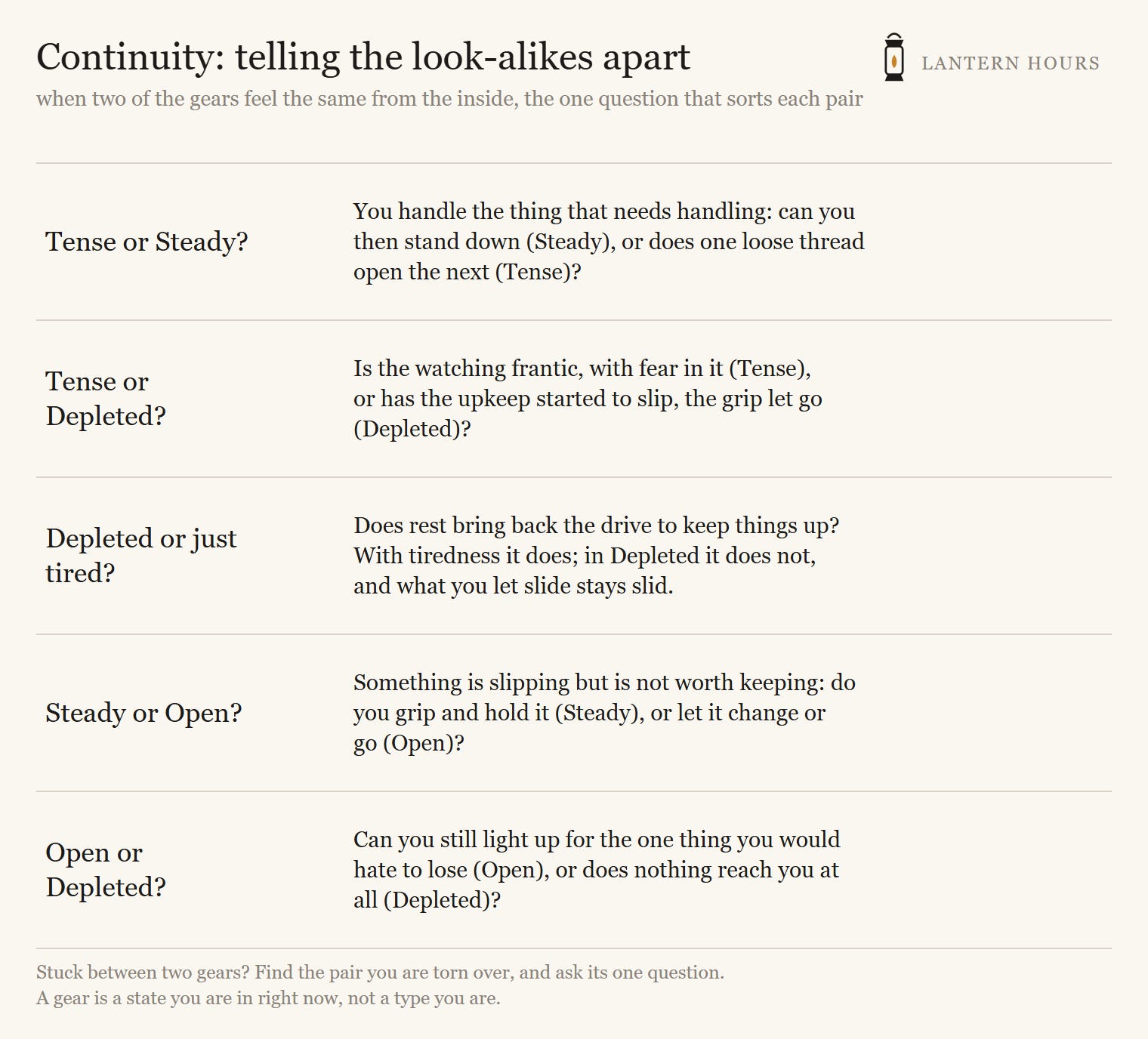
Telling the look-alikes apart: when two of the gears feel the same from the inside, the question that sorts them.
Your orientation does not go away, and it is not meant to. Your orientation is the standing layer underneath, and you would not want to be without it. What moves is the gear, not that standing pull. You are not “a Continuity,” and you are not stuck as the person you are, and the gear can move, though some gears, Depleted especially, move slowly and may need outside help to shift. A costly gear tells you about this stretch of your life. It is not a verdict on who you are. So notice which gear you are in right now, remember it is not permanent, and check your gear again in a month.
From here: the whole framework on one page, all in one place: the four gears, the five orientations, placing yourself, and the pairings people misread.
Or read another orientation: Comparison · Vigilance · Connection · Coherence.