
Vigilance: When You're the Only One Who'll Say It's Wrong
The same sharp eye that can't let a small thing go is the one that catches the real problem first.

His daughter has told a small lie, the kind every child tells. She said she had finished her reading when she plainly had not. He sits her down and explains why it matters. The lie, he tells her, is worse than the unread book. Once people catch you out in one thing, they stop trusting you in the rest. It is a good explanation. He can see her take it in. He has made his point, and this is the moment to stop.
He does not stop. He says it again, the same thing in slightly different words. And each time he names the wrong thing out loud, something in him lets go for a second. A small hit of relief. It is there and gone, and it already pulls him on to say it once more. So he goes a third time. She sits and waits for it to be over. Part of him stands back, watches himself do it, and still cannot bring it to an end.
He is like this with everyone, and always has been. Once he has caught the thing that is wrong and started to name it, he cannot leave it half-said. If you asked him why he could not stop once he had already won, he could not tell you. His eye finds what is wrong and his mouth says it, the way it always has, since long before he could have chosen any of it.
That habit of catching what is wrong, and the small release that comes with the catch, has a name.
Two different things: who you are, and what gear you are in
This piece rests on one idea, and most of the confusion people feel about themselves comes from mixing up the two things it keeps apart.
The first thing is your orientation: a long-term part of who you are, the part that stays much the same year after year. It is usually set early in life, and slow to change. You do not really choose it, and you cannot swap it for a different one, any more than you can decide to start finding different things funny. This framework has five of these long-term parts, each a different thing a person is most tuned to notice and care about.
This one is Vigilance. When Vigilance is your orientation, the thing you are most tuned to notice is what is wrong. The mistake. The danger. The unfair thing. The claim that does not sound true. The thing everyone in the room can see and no one will say. And it is not just that the thing is wrong. It is wrong in a way that should not be allowed to stand, and you feel you have to say so out loud, right then, so it cannot be quietly passed over.
This is not a flaw. At its best, Vigilance is one of the most valuable things a person can bring. You catch the real problem early, the one everyone else walked straight past. You are the reason things stay safe and honest when it would have been easier to look away. And what you are guarding is usually not yourself. It is something the whole group leans on without noticing: that the rule still holds, that people get a fair deal, that the truth stays out in the open. You are the one keeping watch over it.
Underneath it sits one particular fear, and naming it tells you what the catching is for. The fear is that something important is wrong and no one is saying it. That is what makes catching the wrong thing feel urgent, instead of something you could just notice and let go.
There is one more thing about how this feels from the inside, and it explains a lot of the trouble with other people. What you most want is to be heard and to be right. That is why being waved away stings the way it does: you name a real problem and the reply is “you are being negative,” with no one first agreeing you had a point. It can sting worse than the problem itself. What settles you afterwards is not an apology for someone’s tone. It is someone saying, plainly, that you were right.
The second thing is your gear. This is the part people most often get wrong. A gear is how hard or easy your orientation is working right now: how forced or how relaxed it feels this month. It is not a different you. It is the same orientation running hot in one stretch of your life and quiet in another. Which gear you are in is set by how much you are carrying, how well you are sleeping, how safe life feels right now, and how long the stretch has lasted. You do not pick it. You find yourself in one, the way you find yourself coming down with a cold. Your gear can change while your orientation stays exactly where it was.
Take one person. A man whose orientation is Vigilance might, in a calm year, catch what is wrong in a steady, useful way: he spots the problem, says it once, sees it dealt with, and goes home. Two years later, after a long stretch of too much work and too little sleep, the same man, with the same orientation, is different. Now he catches wrong everywhere. He jumps at things that turn out to be nothing. He lies awake running through everything that could go wrong tomorrow. He has not become a different person. His orientation has not moved. What changed is his gear. This is why “Vigilance” can never be the whole story about anyone. Right now you are running Vigilance in one gear, and that gear is a state you are passing through, not a fixed fact about you.
One quick check first. Most people have more than one orientation, and Vigilance may or may not be one of yours. Think back to the last time you walked into a room, opened your messages, or looked at something someone else had finished. Did your eye go straight to the one thing that was wrong and stay there until you had said it out loud? If so, that is Vigilance, and the rest of this piece is for you. If instead you mostly noticed the mood of the room, or who was being left out, that is a different orientation, not this one.
There is one orientation worth pulling apart from Vigilance, because it can look exactly the same from the outside. It is called Coherence. Coherence is tuned to whether things are done properly and kept correct.
Here is the clearest way to tell the two apart, and it is not about who speaks up. Picture two people who both catch the same mistake in a report on the desk in front of them. Both of them flag it, so from the outside they look the same. The difference is where the relief lands. For the first, it comes the moment the wrong is named: saying it out loud lets something in them ease, even if no one ever goes back and fixes it. The catch itself was what they needed. That is Vigilance. For the second, naming it brings no relief at all. Nothing in them settles until the thing is actually right, and a wrong that has been pointed out but not yet put right leaves them just as unsettled as before. What they needed was the thing being right, not the catch. That is Coherence. Same mistake, caught by both. The only difference is where the relief lives: in the naming, or in the thing finally being right.
Underneath, you and Coherence even run on slightly different fears. Yours is that a wrong will go unsaid. Coherence’s is that standards are quietly slipping and no one can tell. Close, but not the same.
There are four gears, and they are not all the same
There are four gears your orientation can be in, and they are not equal. Two are healthy, Steady and Open: you can live in them for the long run without paying a price. The one thing to watch is that Steady has a hidden form, called Hollow Steady, that looks healthy but is not. We come to it in the Steady section. The other two, Tense and Depleted, cost you: stay in them long enough and they wear you down. Some gears are simply better to be in than others.
But being in a costly gear is not a verdict on you. It is not a grade, and it is not a flaw in your character. It is a state, set mostly by what your life has been like lately, and it can change. A costly gear tells you something true about this stretch of your life. It does not tell you who you are.
As you read the four, notice which one fits you right now, this month, not at your best and not at your worst.
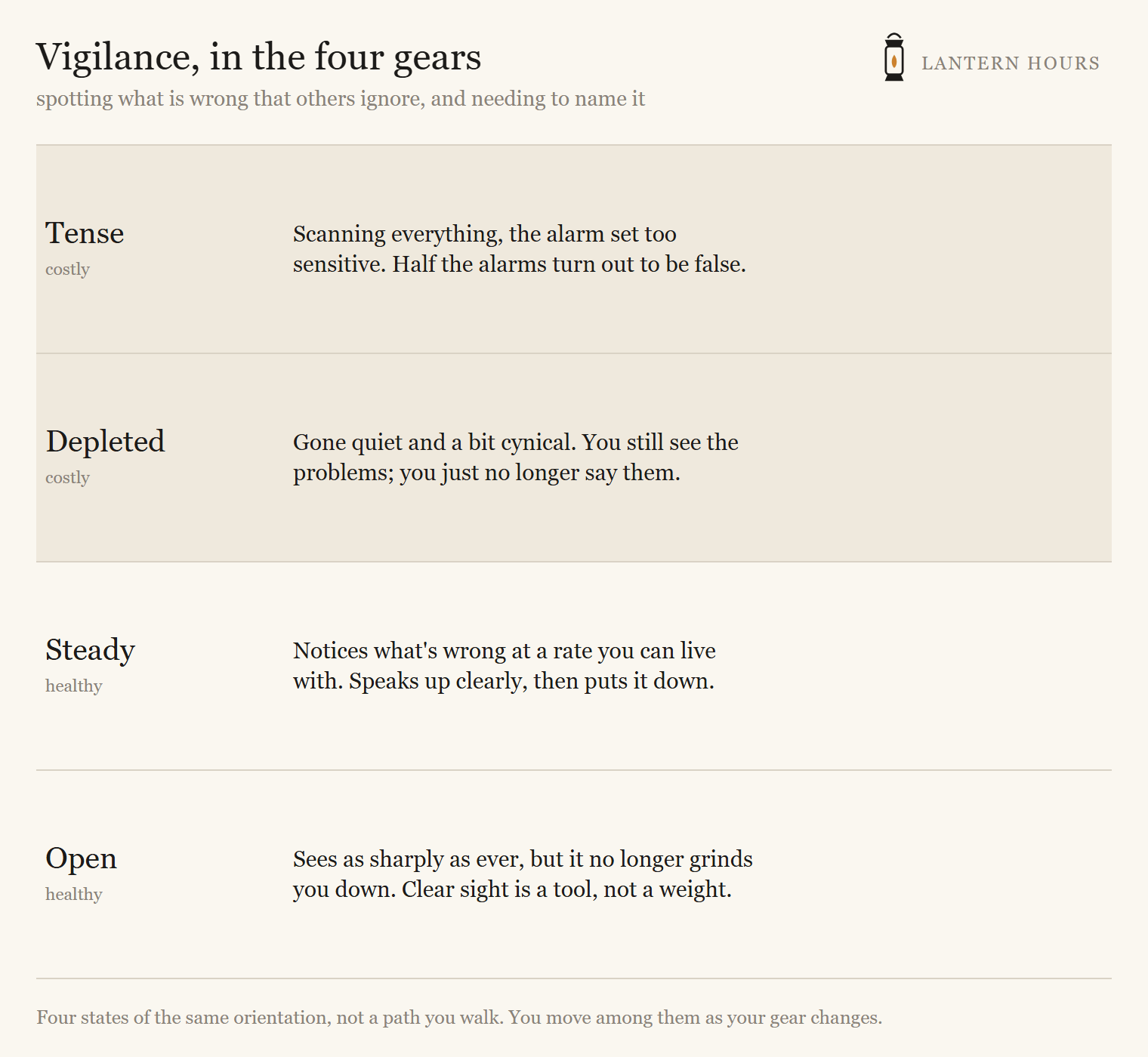
Vigilance in the four gears: four states of one orientation, not a path you climb.
Tense: Vigilance turned up too high
Tense is Vigilance turned up too high, and stuck there. Everything looks like a problem, and you cannot let a single one go. The alarm inside you goes off at small things, and at things that turn out to be nothing. Even after you have said your piece, the tightness does not drain away. You catch one mistake and three more jump out at you. Standing down feels impossible: the moment you stop watching, you are sure something will slip past, and that it will be your fault for not catching it.
What does a day in this gear feel like? Your eye snags on everything: the promise quietly broken, the step someone skipped, the small risk nobody else noticed. You point it out, there is a second of relief, and your attention is already on the next thing. At night your mind keeps scanning, running through everything in tomorrow that could go wrong, and you cannot put it down. Most of what you catch is real, or real enough. But the amount of wrong you are seeing no longer matches the amount that is actually there.
Now the sign that tells this gear apart from plain carefulness, because from the inside the two can feel almost the same. Plenty of people are careful, notice problems, speak up, and are fine. The sign of Tense is not that you catch things. It is that the catching has no off-switch. Catching what is wrong lands with a small hit of relief, the same release that tells you Vigilance is your orientation at all. But in this gear the relief does not let you go; it hands you straight to the next thing. You name one problem, it gets fixed, and within the hour you have found the next, and the next. There is no point where you have caught enough and can stop.
At the family lunch, he said the thing about the money that everyone had spent an hour talking around, and for a second the relief was clean. Then his uncle repeated a story about a neighbour that he knew was not true, so he said so. Then there was the way his sister kept being talked over, and he named that too. Each one let something go in him, there and gone. By the time the plates were cleared he had not stopped once, and across the table his wife had long given up trying to catch his eye.
And running this hot is not a fault in you. It is what a long stretch with no real safety does to a mind built to catch what is wrong, and it eases as life steadies.
One warning matters more than the rest here. Watching this hard, this alarmed, with no real break, is not something you can keep up for ever. The alarm burns out, and you drop into the empty gear below. That drop only goes one way: you can ease off while you are merely tense, but once you have burned down, coming back is slow and not yours to rush.
Depleted: Vigilance run down to empty
Depleted is what is left when Vigilance has been run all the way down to empty. The fear is still true of you, and deep down you still half-see the things going wrong. But the part of you that used to do something about them is gone, and so is the energy. You stop raising things. You let problems slide past that you would once have jumped on, not because they stopped mattering, but because you no longer have it in you to care what happens. The watch has wound down.
From the inside, this gear is easy to mistake for a choice you have made. You expect the worst of everyone and carry it as if you had decided it on purpose: I have stopped expecting better, I do not need to be heard any more. It can sound almost wise, as if you had finally stopped caring about things that were never worth it. But it is not a decision. It is the worn-down feeling talking. The catch that used to bring a clean hit of relief now brings nothing. Where naming the problem once felt sharp and almost satisfying, now it just feels flat.
And do not be fooled by the quiet. For some people this gear does not stay quiet all the time. Every so often a fresh wrong lands close to home, something truly unfair, and the empty gear can blow wide open for a moment: what comes out is far bigger than the thing that set it off, and then it drops back to flat just as fast. If that happens, the flare is not you coming back to life. It is more like the last of the fuel going up at once. So do not take a sudden blow-up as proof the gear has lifted.
Two signs help you place this gear, doing two different jobs. The first tells Depleted apart from Tense: in Tense the alarm is deafening and you cannot switch it off; in Depleted the alarm has gone quiet, and naming the problem brings you nothing. Same watching, no relief. The second tells Depleted apart from plain tiredness: a tired person rests, and after enough rest the spark comes back; here it does not, no matter how much you rest. And if even the watching has gone silent, pay attention. If you have truly stopped noticing what is wrong, stopped caring about almost anything, and the flatness has spread past your watching until it touches everything, then what you are dealing with may be bigger than a gear. The next part is for you.
In the meeting where she would once have flagged three risks before the coffee was poured, she said nothing. She saw the same holes in the plan she always saw, and let it go to the vote anyway. Afterwards a colleague asked if she was alright. She said she was fine, and could not have told him the last time she had actually pushed back on anything.
A few honest words about this gear, because it is the one that needs them. If this has been your state for months rather than weeks, and the things that used to move you have gone flat, it is the least likely of the four to lift just because you wait or push harder. It is worth talking to someone trained to help, a doctor or a counsellor. That is not a diagnosis, and it does not mean something is wrong with who you are. It is the same plain sense that takes you to a doctor for a pain that will not go away. You would not call that weakness, and this is no different. And this gear hides best from the person inside it: the flatness that is the problem is the very thing that stops you minding it. So if the people who know you keep saying you have gone quiet or switched off, let that count for more than your own read.
Steady: Vigilance at a level you can hold
Steady is Vigilance running at a level you can actually hold, month after month, without it costing you. You still watch for what is wrong, and still catch the things that matter. The orientation has not gone anywhere, and it is not supposed to. What has changed is that your sense of who you are no longer rests on catching every single thing. You can miss something now and then, and it does not wreck you.
What does this feel like from the inside? The watching is still there and still working: you see the problem, say it once, plainly, and it gets dealt with. But it runs at a pace you could keep up for a long time, not the round-the-clock watching that leaves you wrecked. You catch what is wrong because catching it is useful, not because your worth depends on having caught it. And when you do miss something, you put it right if you can, and do not spend the night taking yourself apart over it.
Here is how to tell this gear from Tense, the hot one it is most often mixed up with. The test is whether you can stand down. In Tense the watching never switches off, and one caught problem only opens the door to the next. In Steady the watching has an off switch: you find a real problem, name it, deal with it, and then genuinely let it go and get on with your day, instead of going straight off to hunt for the next one.
One important exception: a steady surface can quietly go hollow. There is a form of Steady that is not healthy, and it is the hardest state in this whole map to catch. Its name is Hollow Steady. From the outside it looks like steady, reliable vigilance: you still catch what is wrong, still name it, still hold the line, exactly as you always have. What has drained away is the belief that any of it matters, that being heard is possible, that naming the problem will change anything. The watching runs on perfectly. The hope that gave it a point is gone.
She still flagged every risk in the team’s plans, the way she had for years, naming each one clearly and on time. No one would have guessed anything had changed. But somewhere along the way she had stopped believing any of it would get heard, or get better, or matter at all, and she named the risks now the way you read out a weather report for a place you will never visit.
Do not mix this up with Depleted. In Depleted the watch winds down and it shows: you go quiet, you stop raising things, and the people around you can see you have checked out. Hollow Steady is the opposite. You keep catching and naming everything, flawlessly, so from the outside you look as sharp as ever, and no one, including you, is likely to notice the belief underneath has gone. That invisibility is what makes it the most dangerous form on this map.
Hold this one lightly, because it is easy to get wrong: most people who worry that they have gone hollow have not. They are just worn thin by a stretch where nothing they flagged ever got fixed. Here is the honest test. When something you raise actually gets taken seriously and put right, does it land, does it bring the old clean relief? If it does, you were worn down, not hollow. If the relief never comes no matter what gets fixed, and it has gone on for months, that is worth an honest look from someone who knew you when it still mattered, and worth talking to someone trained to help.
This gear has a blind spot worth naming. Of all four, Steady is where a slow slide into the empty gear is hardest to catch, in yourself most of all. You can keep catching things at a calm, even pace while the relief quietly drains out of it: you still flag the same problems, but care less and less underneath. That can look exactly like healthy Steady, right up until there is nothing left underneath. So if you landed on Steady because you feel calm, that calm is the one answer in this piece most worth a second, honest look. Ask whether you are calm because things really can keep going like this, or because the feeling has quietly gone out of it. The people close to you will often see which it is before you do.
He caught that a customer was being charged for a service they had cancelled months ago, money they plainly did not owe. He felt the small, familiar lift of having spotted it, there and gone, then sent the one email it needed to put it right and closed the laptop. The old version of him would have checked every other customer’s bill that night, just in case. This time he made a cup of tea and watched the rest of the show. The bills were still there in the morning, and so was he.
Open: Vigilance still sharp, but no longer sounding the alarm
Open is Vigilance that is still fully there, but no longer running the show. You see what is wrong as clearly as ever. The orientation has not dimmed, and the eye for what is wrong works exactly as it always has. The difference is that seeing the problem no longer forces you to sound the alarm every time. You can look straight at something that is truly wrong, decide that here, today, it does not matter, and let it sit there without saying a word.
What does this look like from the inside? You notice the flaw, and almost without effort ask whether this one is worth it. Most of the time the answer is no, and that is fine: you deal with the part that matters and let the rest go. Letting go costs you nothing, because catching it was never the thing holding you together. And the sharp eye does not just sit idle. You point it, on purpose, at the one thing you really care about keeping safe: a person you do not want to see hurt, a truth you want kept in the open, work you mean to get right. The watch is still sharp, and now you are the one aiming it, at what you have chosen to guard.
Here is how to tell Open from Steady, because from a distance they look almost the same. Both watch, and both can let a missed thing go without falling apart. The difference shows up with a problem that is real but does not matter. Steady still tends to step in and put it right, just because it is there and it is wrong. Open sees the same problem, decides it does not matter here, and leaves it alone on purpose, dealing only with the part that really counts.
And one more sign keeps Open clearly apart from the empty gear. “No longer sounding the alarm at everything” could be mistaken for “no longer able to care.” The difference is that in Open you can still fully step in the moment something truly matters. The watching is there and ready; it has simply stopped going off at everything by default. Flat and past caring is Depleted. Able to see clearly, able to act when it counts, and no longer ruled by the need to catch everything: that is Open.
For Vigilance, this is the rarest gear of the four. When your whole orientation is built around the danger of letting something slip past, standing down feels like a risk in itself, and something in you resists it. So Open is not a switch you flip by deciding to relax. It tends to come slowly, usually only once life has felt safe long enough that the watch can finally loosen its grip.
She noticed the new worker’s slides were full of small claims that did not quite hold up, forty little exaggerations that made the product sound surer than it really was. It was a bit misleading, and she felt the old urge to put all forty right. She fixed the one claim the client would actually act on, left the rest exactly as they were, and said nothing about it to anyone.
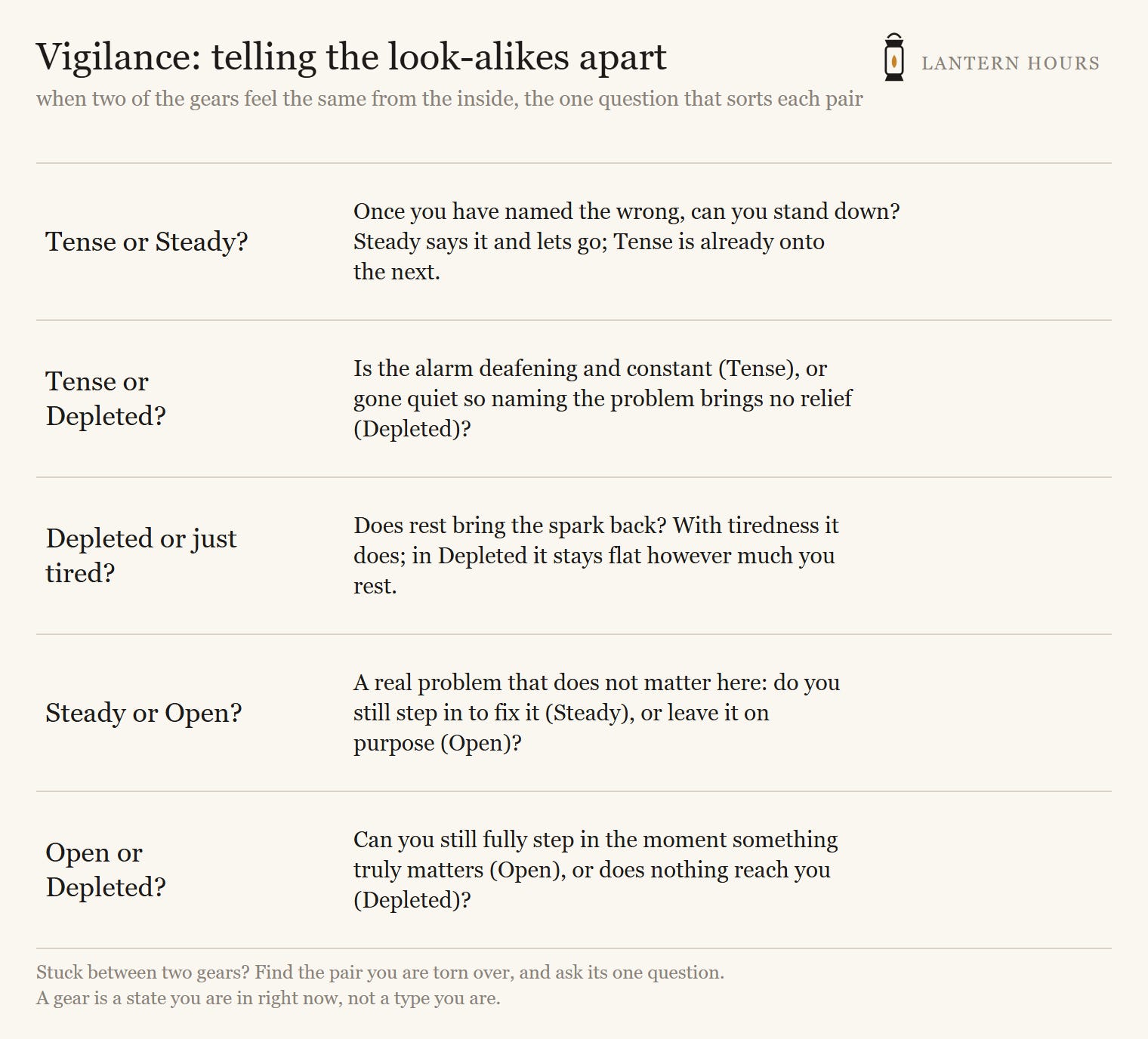
Telling the look-alikes apart: when two of the gears feel the same from the inside, the question that sorts them.
Vigilance does not go away, and it is not meant to. You cannot get rid of your own orientation, and you would not want to: it is part of how you are built, and in a healthy gear it is one of the best things about you. So nothing here asks you to stop catching what is wrong, or to become someone else. What changes is the gear, not the orientation.
That is the point to carry away. You are not “a Vigilance,” as if that were a fixed label stamped on you. And you are not stuck in Tense or Depleted, even if that is where you are today. If one of the four gears felt most like you, that is simply the gear you are in right now, in this stretch of your life. Gears change. The empty one lifts more slowly than the rest, and is the one most worth getting help with. A costly gear is telling you something true about this stretch. It is not telling you who you are, or who you will always be. So do three small things. Notice which gear you are in. Remember it will not last for ever. And check again in a month, because by then it may already have moved.
From here: the whole framework on one page, all in one place: the four gears, the five orientations, placing yourself, and the pairings people misread.
Or read another orientation: Comparison · Connection · Continuity · Coherence.