
Why Losing an Argument Feels Like Losing Yourself
Most beliefs you can swap without fuss. A few are part of who you are, and a challenge to those feels like an attack. What to do the moment you feel it.

Daniel is at his sister’s kitchen table when his brother-in-law says something about how the local schools are run. It is not even a big deal. But it goes against a claim Daniel has held for years, and the moment he hears it, his chest goes tight and his face goes warm. He is already building his answer while his brother-in-law is still talking. He hears just enough to argue back.
For half a second, right at the start, a small part of him thinks: he might have a point. Then something in him braces. Daniel leans in and takes the claim apart, piece by piece, sharper than he needs to be. His sister goes quiet. His brother-in-law goes quiet. The evening does not recover.
Later, driving home, he replays it. And here is the strange part. He is not sure he was even right, or that he ever was. But in that kitchen, being wrong was not something he could reach.
If you have done this, and most of us have, it is worth knowing what it actually is. It is not that you are stupid. It is not that you are stubborn. It is your sense of who you are, defending itself.
Some beliefs you hold, and a few you stand on
Most of your beliefs are things you hold in your hands. Whether a shortcut really saves time, whether a film was any good. If someone shows you a good reason, you look at what you are holding, turn it over, and swap it. No fuss. You can put it down and still be exactly who you are.
But a few beliefs are not in your hands. They are the ground you stand on. A belief about what kind of person you are, about what your side stands for, about how the world really works. You are not holding those. Your whole weight is on them.
That is why a challenge to one of them does not arrive as information. When someone digs at the ground under your feet, you do not weigh what they found. You brace, tensing against it. Your body catches its balance before you have had a single thought, and kicks away whatever they dug up. That is why the feeling is heat, not curiosity. A challenge to a belief in your hands says “you might be holding the wrong thing.” A challenge to the ground says “you might have nothing under you.”
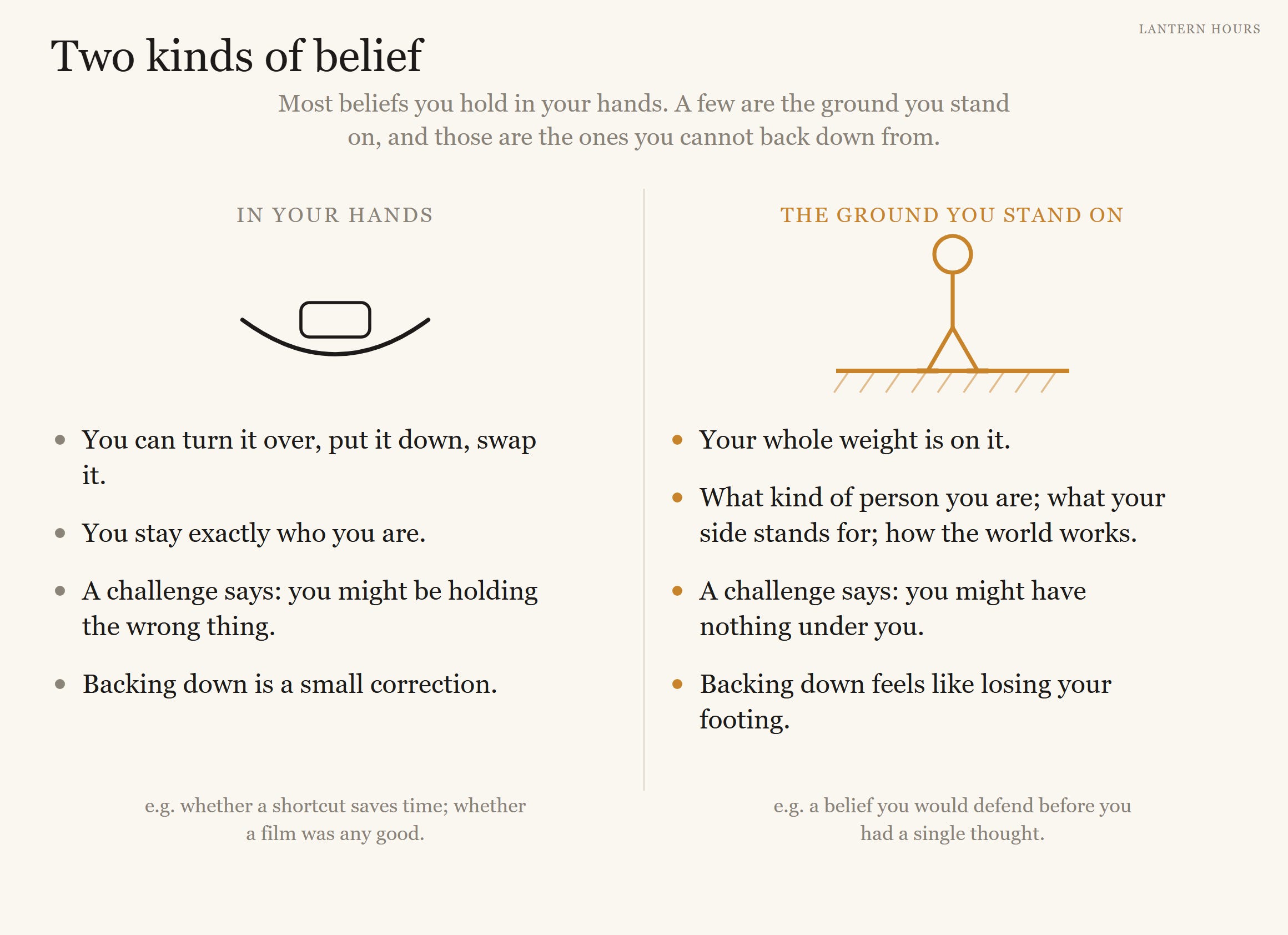
And backing down carries a cost you feel straight away. Being wrong out loud, in front of someone, stings. Being more right is a reward that comes later, if it comes at all, and you cannot feel it yet. So when you hold your ground, it is not the crazy choice it looks like from the outside. In the moment, it is the reasonable one.
And it does not even take a real attack. Someone only has to mention the ground you stand on, and you are already defending it. Your footing may be solid. But while you are busy holding that one spot, you stop hearing the rest of what they said, and the rest is often where they had a point you could have learned from. Being right about the ground does not save you from missing the rest.
In front of someone, backing down feels like losing, not learning
The challenge usually comes with other people around: at the kitchen table, in a meeting, in a group chat. That changes everything. Stepping off the spot now is not just correcting a fact. It is being seen to lose your footing.
And here is the trap inside the trap. You cannot defend a piece of ground without standing on it where everyone can see. The harder you plant your feet, the more clearly everyone sees where you stand. Defending the belief and showing it off are the same act. That is what commits you to holding the spot in front of them.
An audience is the quiet switch that turns a conversation into a contest. Once it is a contest, there is a winner and a loser, and no one wants to be the loser in front of people they care about. This is how you can end up losing a relationship over a point you were not even sure of. By then you were not really defending the belief. You were defending your pride. The fact you were arguing about still matters, of course. But the reason it got loud was often the audience, not the fact.
One question tells you what you are standing on
So how do you tell the two kinds of belief apart in yourself? Ask one thing: can I change my mind about this without it feeling like I would stop being me? If changing it would be a small correction, it is in your hands. If it feels like losing a piece of yourself, you are standing on it.
Here is a sharper version of the same test. Imagine you were quietly proven wrong, and no one would ever know. Would that be a relief, or would it still be unbearable? If it is a relief, the fight was about being seen. If it is still unbearable, the belief is not in your hands at all. It is under your feet.
Notice that you are only standing on a few spots, not on everything you believe. That matters, because it means you are not “a closed-minded person.” You will not budge on this one, and this one, under certain conditions. Some people stumble in the heat and have their balance back within the hour. Others have not shifted in years. They are not the same.
One caution. Standing firm does not prove the ground is solid. Sometimes a person stamps hardest exactly where they can feel a crack. But it feels the same either way, so do not read your own heat as a verdict, in either direction. And if you can even ask yourself these questions, if you feel the regret on the drive home, you are not one of the truly stuck.
When a value has grown into the belief, the challenge feels unfair
Sometimes it goes further. The belief is not just a claim about how things are. A value has grown into it, a sense of how things should be. When that happens, a challenge does not feel wrong. It feels unfair. The other person is not just mistaken; they are doing something you experience as an offense. And you cannot pull apart “this is false” from “this should not be.”
When you are here, more facts will not help, because you are not really in a fact argument. What helps is pulling the two apart. Pick the factual part up and put it back in your hands, where you can turn it over. The value stays under your feet. You can keep standing on what you care about while the belief about the facts changes. They only felt like one thing.
You cannot argue yourself calm, but you can look at what they dug up
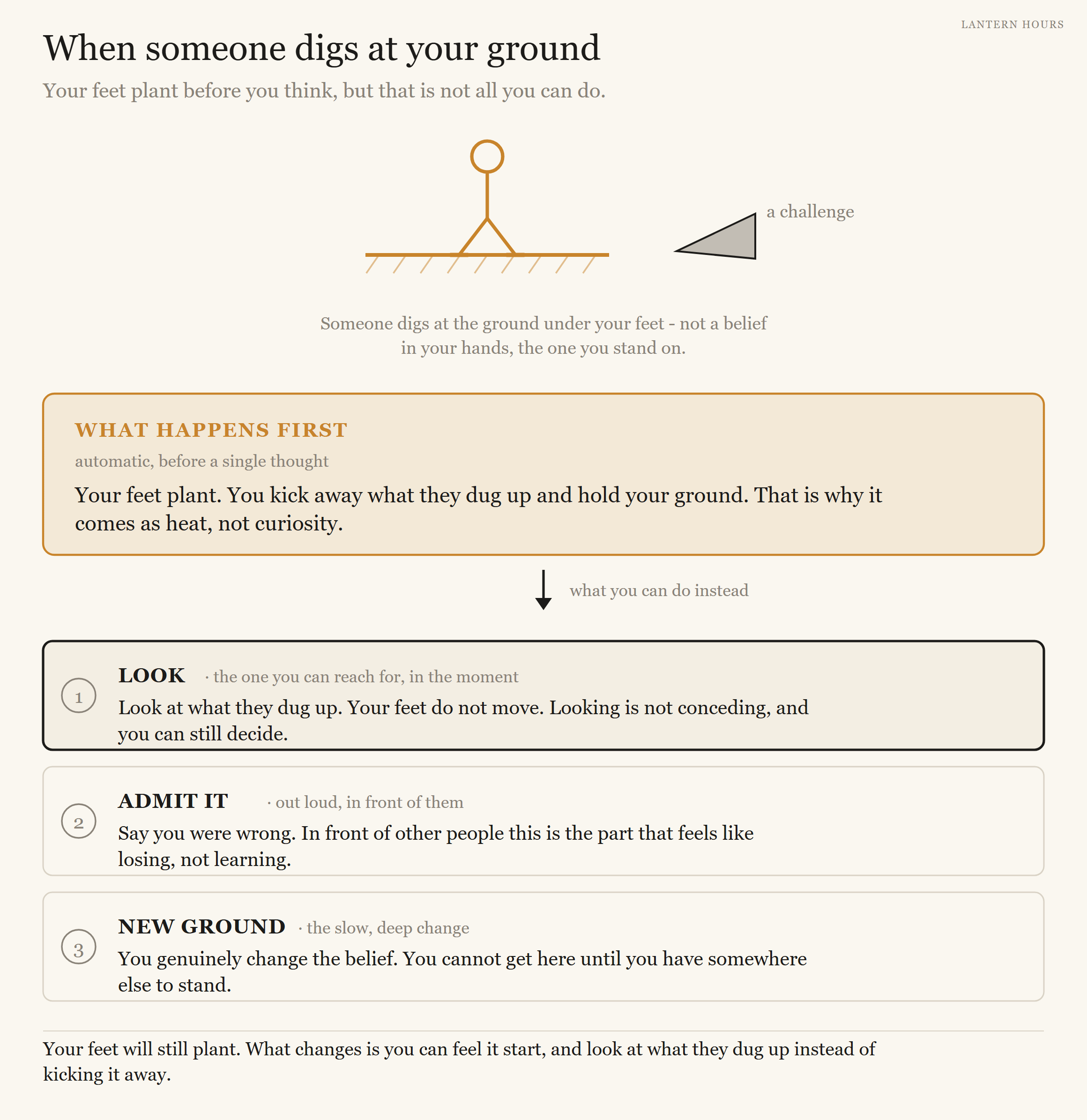
The moment you feel the heat rise, you will not reason yourself calm. Nobody argues with their own balance. Catch the feeling as it starts, and name it to yourself: I am bracing. This feels like an attack on me, not on the idea. Naming it buys you half a second before you react.
In that half second, remember you do not have to defend anything right now. If they are wrong, their words have not touched what is true, so there is nothing to protect. If they are right, defending will not make you less wrong, only harder to stop. Either way, wanting to defend does not mean you have to. And the harder you push, the more it looks like the point needs defending, which only makes it worse.
So do something smaller instead. Ask a real question, not a trap. Or say you need time to think it over, because almost no one needs your answer this second. You are only looking at what they dug up, and looking does not move your feet. Then, calmer, you can decide whether to make your case or let it go. Curiosity is not a feeling you have to wait for. You can ask the question while you are still hot, and the feeling sometimes follows.
How far you get depends on the ground. If this is a stumble, naming it and asking a question may be enough. If you have stood on this spot for twenty years, one look will not shift it, and it should not. That is slower work, and it starts small: one caught feeling, one real question, one time you did not kick the evidence away.
And keep one rule for the worst case. When you feel yourself ready to lose the relationship just to win the argument, that is the signal to stop. Not because you are wrong. Because no point is worth the person across the table. This is for small points fought too hard, not for a real wrong or a line you cannot give up.
What changes, and what does not
You will always feel yourself start to defend. It is old, and it will not dissolve because you read about it. What changes is that you can catch it now. You can tell the difference between your feet planting themselves and you actually deciding something. In that difference, you can choose to look at what they dug up instead of kicking it away.
The deeper change, being able to hear that you were wrong without it costing you a piece of yourself, is slow. What makes it slow is fear. It feels as if stepping off this ground means falling, with nothing underneath. You have stood here so long that this one belief seems like the only thing holding you up. But other people stand on different ground and do not fall. Step off, and most of the time you find you can still stand. That is more than a piece of writing can hand you. And if you have already lost someone this way, reaching back to them is its own act.
But the next time you feel your chest go tight at the kitchen table, you will know what it is. Your feet, answering before you do. That is where it starts.
This is one of the ways an always-on-guard mind protects itself. The next piece is about building a place to stand no single fact can knock down. And sometimes a person who knows you well can see what you are standing on faster than you can.