
You got what you wanted. Why doesn't it feel like anything?
Two reasons a win can feel flat: the good feeling fades, or your standard keeps climbing. They need different fixes, and winning bigger fixes neither.

For six years, Priya saved to buy her own home. She kept a spreadsheet. She skipped trips. She said no to a hundred small things. She had a photo of the kind of place she wanted, and she looked at it on the bad days.
The day the call came to say her offer had been accepted, she cried in the car before she could even drive home. She called her sister and couldn’t stop talking. For the rest of that week she felt light, like she had finally set down something she’d been carrying for years.
Then it faded. By the Tuesday in March when she got the keys, it was already gone. They felt heavier in her hand than she thought they would. She walked into the empty living room she had pictured so many times, and waited to feel it again.
It didn’t come. Not relief. Not pride. Just bare walls, and a list already starting in her head: the boxes, the internet, the leak under the sink. She sat on the floor and ate takeout. She called her sister again and said it went fine. That night she lay in bed, not happy and not sad, wondering why the thing she had worked six years for already felt like any other day.
Maybe you know that feeling. You work toward something for a long time. You get it. And it does not feel the way you thought it would.
When that happens, it is easy to decide something is wrong with you. That you are ungrateful. That you just needed to want it more. That part is almost never true: it is not a flaw in your character, and wanting it more would not have helped. But the flat feeling is real, and for some people it points to something they can actually change. To see whether yours is one of them, start with a simpler question: what makes a win feel good in the first place?
Picture a glass of water
Think of how good you feel about yourself as water in a glass.
Now draw a line on the side of the glass. That line is the level you expect of yourself: the point where you would feel you had done enough. When the water is above the line, you feel good about yourself. When it sits below the line, you do not, even if the glass is nearly full.
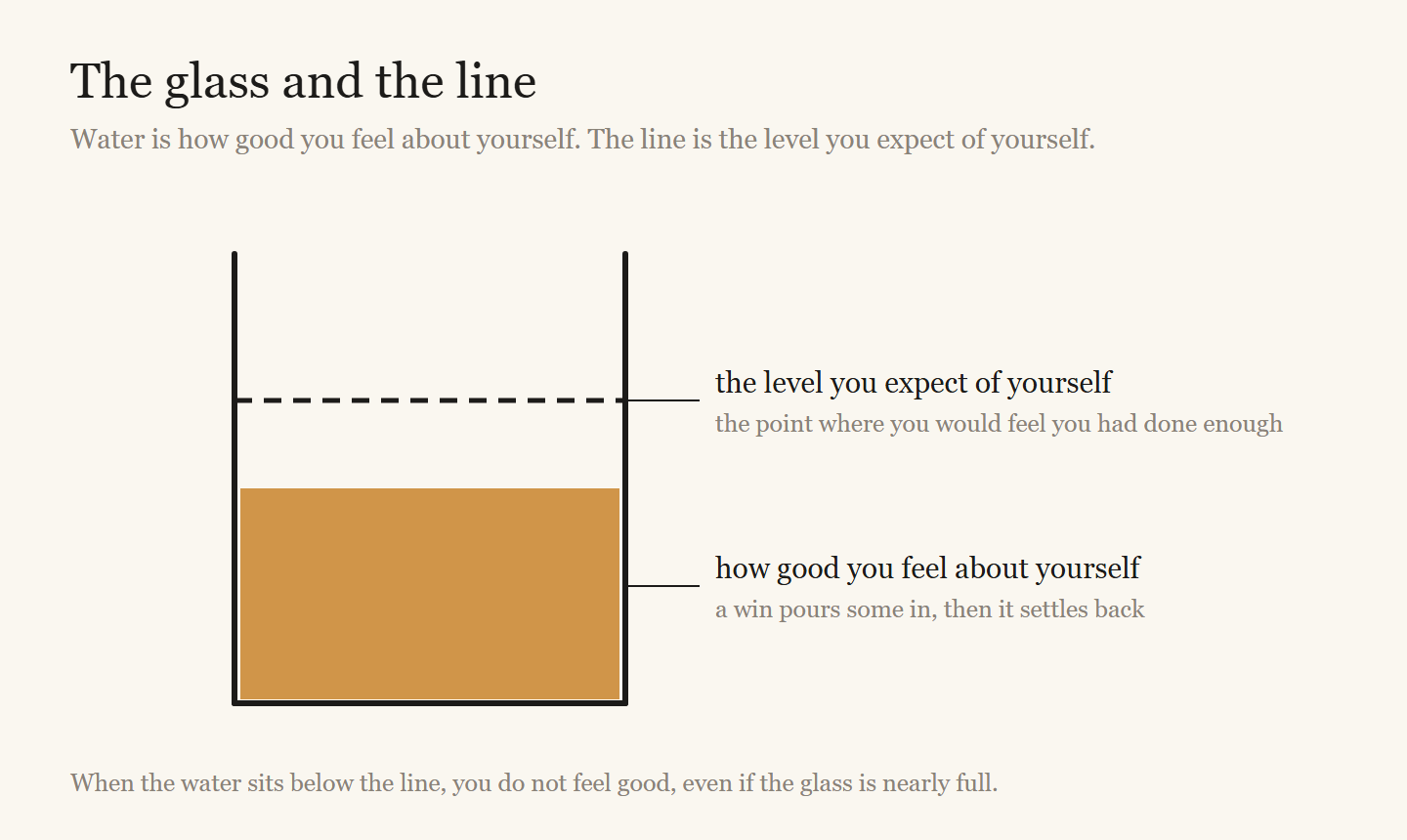
The two parts of the picture: the water (how good you feel about yourself) and the line (the level you expect).
So a win feels good when it leaves you above the line. And there are only two ways to get there. You can raise the water, by doing more than you did before. Or you can lower the line, so that you already stand above it. Both work, because both leave you with water above the line. The second is not the same as settling for less, though it can sound like it. Almost everyone leans on the first and forgets the second even exists. Hold onto that: the forgotten one is half of what follows.
The first reason: the water drains back down
Raise the water and you do feel good. You worked, you got there, the water rose above the line. But then, over a few hours or days, the water drains back down to about where it was before. You get used to the win, the lift leaks away, and you are no longer above the line.
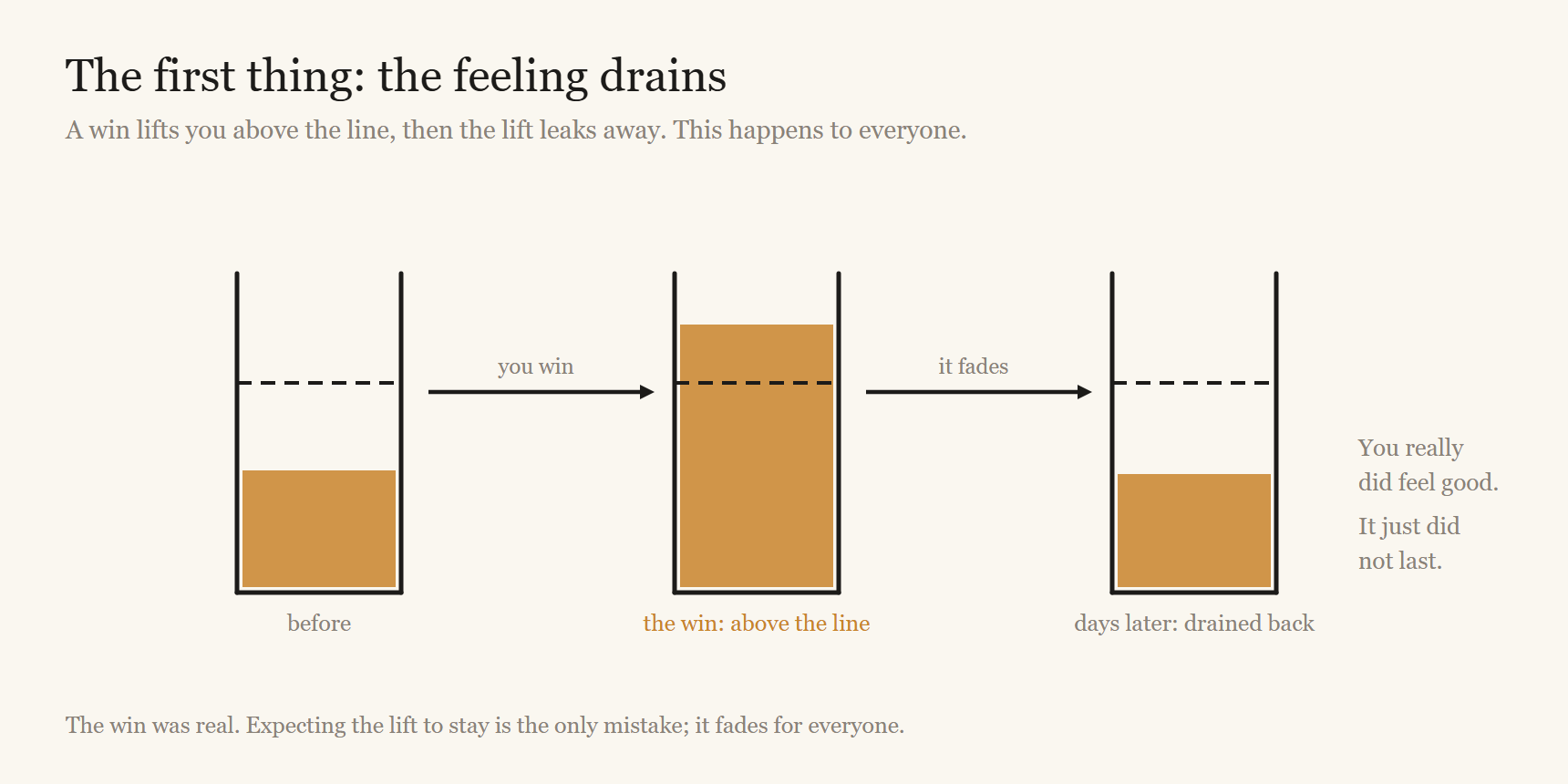
A win lifts the water above the line, then it drains back down. The win was real; the lift never lasts, for anyone.
This happens to everyone. You cannot keep that good feeling forever, any more than you can stay thrilled by a song you have played a thousand times. Feeling happy and then moving on is not a fault. It is how feelings work. So if a win lifted you and then faded, nothing is wrong with you. The only mistake is expecting the lift to last. It never does, for anyone. You will know this one because the win did land at first. You felt good, and then within a few days the feeling drained away.
But a win actually gives you two different things, and only one of them drains. One is the feeling of winning, which always goes. The other is whatever the win changed about your life, which can stay.
Look again at Priya. The lift of buying the house faded within weeks, exactly as it had to. But the house itself did not. The warm, dry, safe place she comes back to every evening is a real and lasting good, long after the feeling of buying it is gone. That is the part of a win that stays: not the feeling, but what it changed. A house, a skill, your health, the people around you, those quietly raise the level your days settle at. A trophy, a title, a number on a page give you the feeling and nothing underneath. So part of why a win feels like nothing is that you were waiting on the feeling, which always leaves, and you walked straight past the lasting thing the win actually left you.
The second reason: the line climbs ahead of you
For some people the trouble is the line, not the water. The line sits ahead of where they are, and it keeps moving ahead. Sometimes it was set high from the start, a standard almost no one could meet. Sometimes it is set by the people in front of you, so it sits wherever they are, not where you are. Sometimes it slides forward the moment you reach it. Either way, a real win raises the water, but the line has already moved higher, so you are still below it, no higher than “not enough yet.”
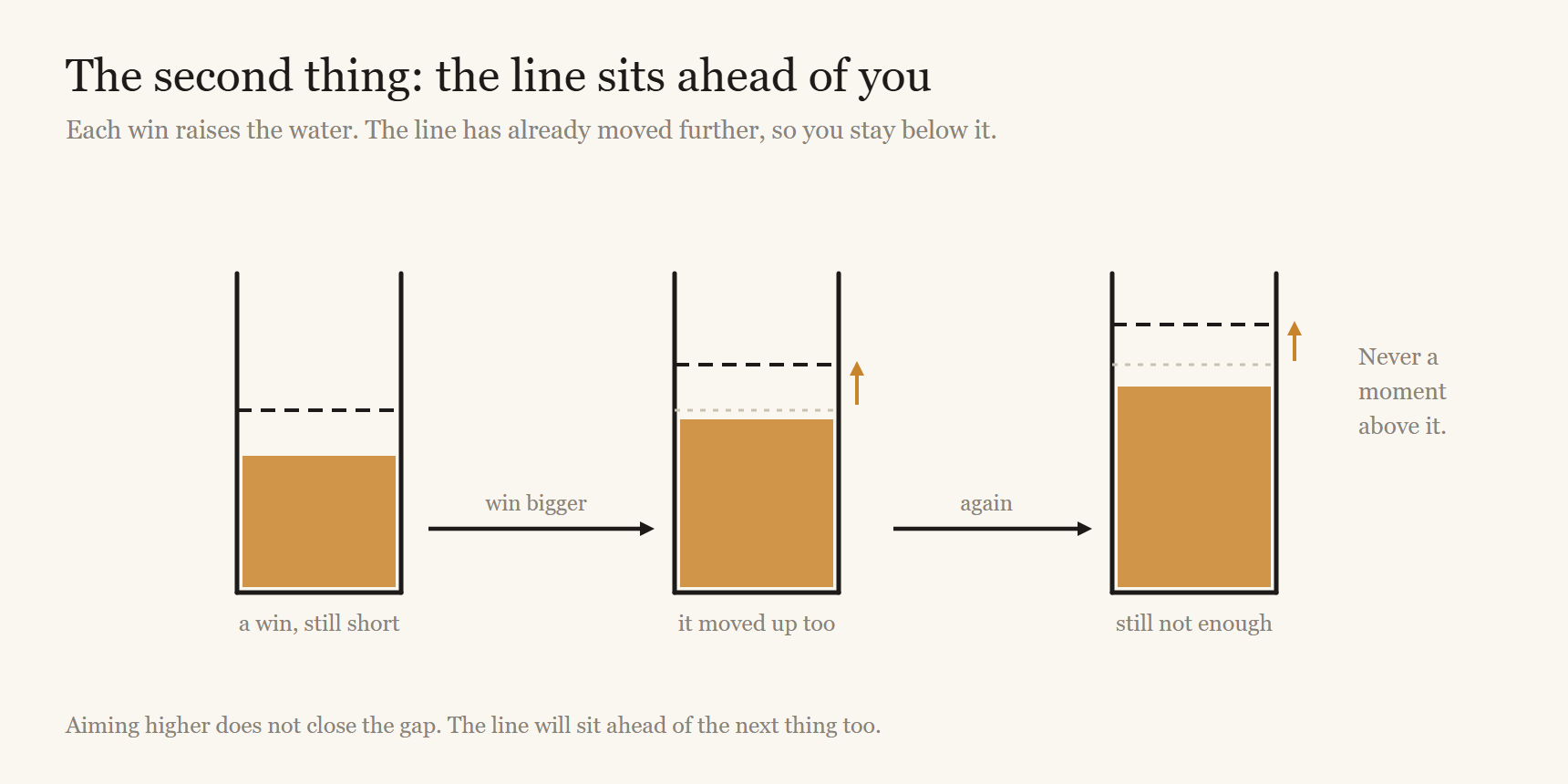
Here the line sits ahead of you and keeps moving. Each win raises the water, but the line has already moved further, so you stay below it.
Picture someone who has wanted to make manager for years. He gets it, and on the day it happens he feels almost nothing, because by then “manager” no longer counts as far enough. Now the real test is director. He cannot point to a single moment in his whole career when he felt he had made it, no matter how much he has actually done.
You might think the answer is the second of the two ways from before: just lower the line. But here is the catch. For this person the line does not stay where you put it. It climbs back up on its own the moment they stop holding it down, resetting to sit just ahead of wherever they now are. So a bigger win cannot help, because the line will simply move again. You will know this one because even after a win you feel behind. Not empty, exactly, but never enough.
The fix you reach for first, and the two that work
The move almost everyone reaches for is the same: win bigger. Raise the water higher. It feels like the obvious answer, and it fixes neither reason. If your feeling drains, a bigger win just drains too. If your line sits ahead, a bigger win is met by a higher line. Either way you are back below the line within days, already reaching for the next one.
The two real fixes are different, one for each reason.
If your feeling drains, stop waiting for the feeling to come back, because it will not. Let one win actually count before you reach for the next, and lean on the part that lasts: the home, the skill, the people a win brought you, rather than the lift that left.
If your line sits ahead, stop trying to climb to it. Bring the line down to where you can stand above it. Measure yourself against where you came from, not against where you are heading: the version of you from ten years ago who wanted exactly what you now have.
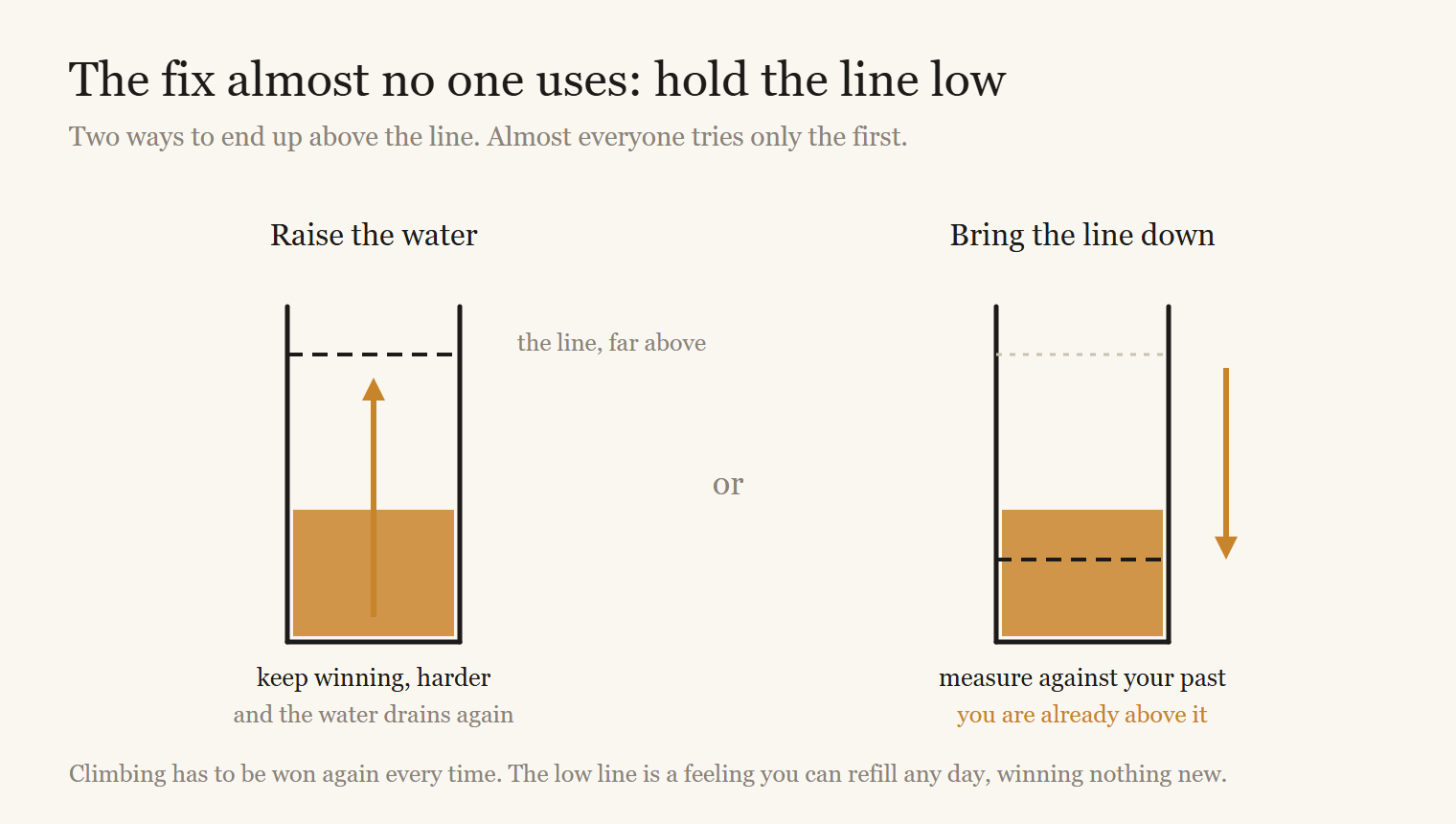
Two ways to end up above the line: raise the water (tiring, and it drains), or bring the line down to your real past, where you already stand above it.
This is not “just be grateful,” which usually does nothing. Being grateful for the win only pours more water into a glass whose line is too high. The move is about the line, not the water. And it is not done once. You have to keep choosing that lower line, because the mind drifts it back up to “where I should be” the moment you stop. But it is a feeling you can refill on your own, any day, without winning anything new. The person who only knows how to win bigger cannot.
Is your good feeling the kind you can lose?
Both reasons come from the same root. In each one, how good you feel about yourself depends on what you achieve, so it drops when you do not do well enough, and it drops when someone else does better. That points to a simple test you can run on anything you have tied that good feeling to.
Could a single bad day, or someone else doing better, take it away from you and keep it?
If yes, it is the kind of good feeling you can lose. It will keep letting you down, because it has to be won all over again every time. And it is expensive: because it has to be earned, then earned again, you keep paying for it year after year, in the time that goes straight to the next thing, the breaks you skip, the parts of your life you keep putting off behind the work.
If no, it is the solid kind that no result can reach. The difference is not the subject; it is the source. The kind you can lose rests on how you compare with other people, which you do not control and can lose any day. The solid kind rests on what you keep choosing to do: being someone people can count on, treating people decently, doing your work honestly. No result can take those from you, because they were never a contest. The more of that good feeling rests there, the less any of this can touch you.
Knowing the reason does not change the feeling
You can understand exactly why your wins feel like nothing, agree with all of it, and still feel the next one fade or never arrive. Knowing the reason does not make the feeling move.
A good feeling about yourself is not a belief you can talk yourself into. You can be completely sure you did a great deal, and still feel nothing. It is more like being afraid of the dark: you can know, for a fact, that nothing is there, and still feel the fear. The feeling follows where you are standing and what you measure against, not what you understand. Reading this has not changed where you stand. Only doing the moves above will.
Other reasons a win can feel like nothing
Not every win that feels like nothing comes from this trap. A few cases look like it and work differently.
Your life changed, so you moved the line yourself. If what counts as “enough” changed because a child arrived, or you lost someone, or you found work you genuinely care about, that is not the trap. You moved the line on purpose, and it stays where you set it. Only a line that climbs on its own is the trap.
You never really wanted it. Sometimes a win feels like nothing because you did it only because you felt you had to, and a thing done that way does not pay you in good feeling. That is a different problem with a different cure, and it deserves its own piece.
You saw it coming. Sometimes you knew it was coming for so long that there was no surprise left, so by the time it arrived it was old news. The win was spent before you reached it.
Almost nothing has felt good for a long time. Sometimes a win you fully believe you earned still feels like nothing, while almost nothing else has felt good for a long while either. Then the trouble may not be about your worth at all. The ability to feel good can dim for a time, and gratitude or slowing down will not reach that. That is closer to depression, and it is worth taking to someone who can help. The clue is this: is it only your wins that feel like nothing, or almost everything?
Your moods swing high, then crash. If your moods run the other way, lifting high for days and then dropping so low you cannot keep up with ordinary life, again and again, that is also not something you fix by where you put a line. It is worth taking to someone who can help. A normal high after a win that settles in a few days is not this. The clue is whether the swings are big enough, and often enough, to knock ordinary life off course.
No single win settles it
No single achievement settles the question of whether you are enough, and the answer is not a bigger one. The next win will fail the same way, because that was never the part that was broken. The flat feeling was never a fault in you. What actually changes things is slower and quieter: putting the line where you can stand above it, leaning on what a win really leaves behind, and resting less of how you feel about yourself on the next result. The feeling will keep doing what feelings do. The most you can do is stop chasing a line that runs ahead of you, let one win actually count, and let that be enough.
Two parts of this are not in doubt: good feelings fade, and people quietly raise their own targets on themselves. Seeing a win as the moment you rise above your own line is the way this piece chooses to look at it, not a settled fact. What is really yours to find out is whether you can set that line low and leave it there.
From here: the whole framework on one page, the four gears, the five orientations, and the pairings people misread: the framework. The orientation this piece sits closest to is Comparison.