
Gear & Orientation: The Two Layers of You
A small framework for telling apart who you are this month from who you are underneath.

You have probably taken a personality test at some point. Forty questions on a quiet afternoon, and at the end a neat answer about what you are. Maybe it even felt right at the time. Then a hard month came. You snapped at people you love. You slept badly. You looked at that neat answer and saw nothing of yourself in it, and it quietly stopped meaning anything.
That does not mean you are impossible to know. It means the test mixed up two different things. One is what you were like that month. The other is what you are like underneath, year after year. This page is a small framework for telling those two apart. It reads you as two things at the same time. The first is the gear you are in right now: the half of you that moves and changes. The second is the orientation underneath: the half that stays. That is the whole idea, and it is why the framework is called Gear and Orientation. You can use it on yourself, and on the people around you.
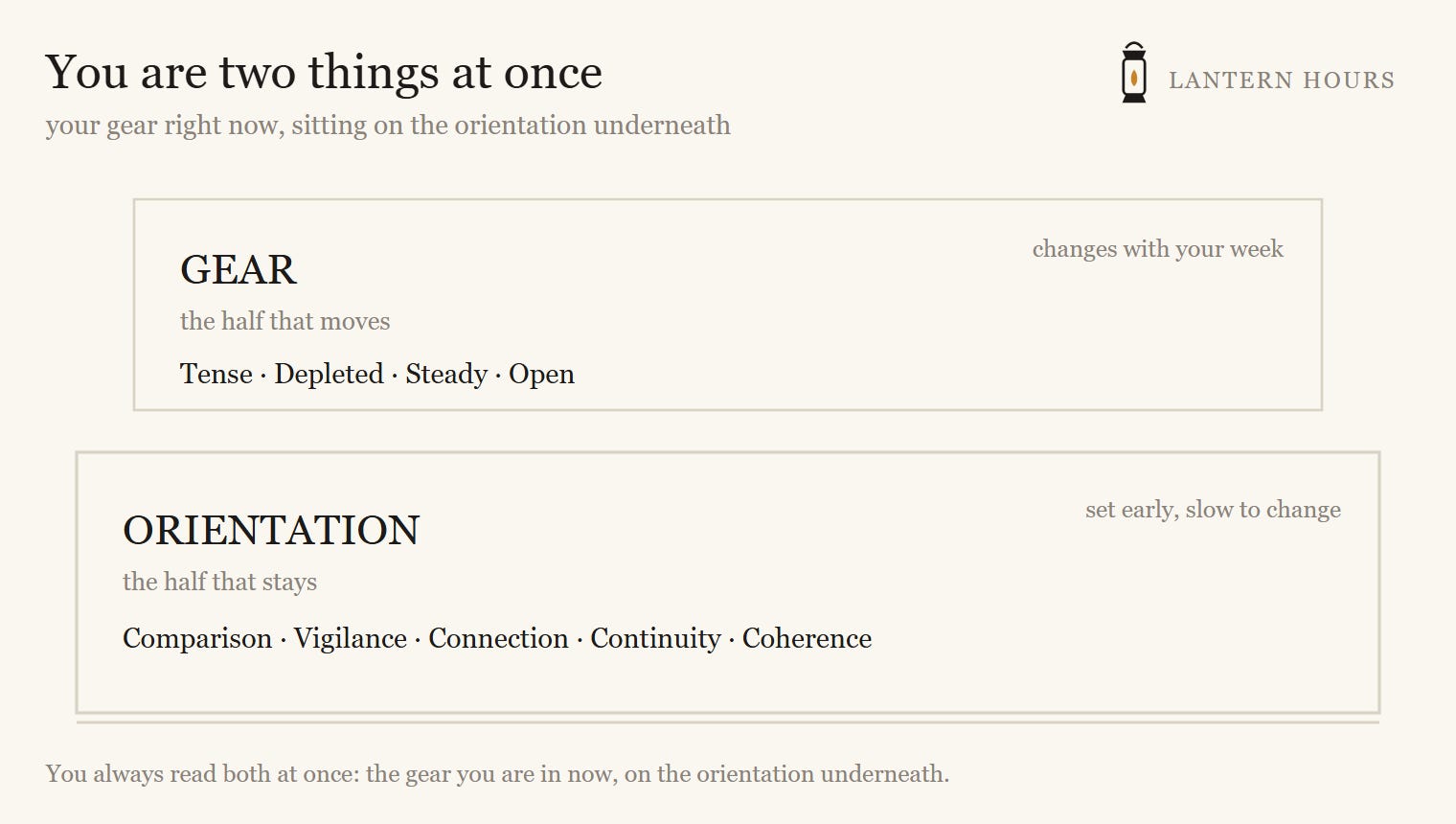
You are read as two things at once: the gear you are in now, and the orientation underneath.
This is the whole framework, on one page. You do not have to read it start to finish, and no part needs another first. New here? Just read straight down. Came with one question? Jump to it in the list below. Came in with a specific problem? You can browse by the problem you have and start there instead.
What’s on this page
The four gears: the gear you are running in right now, what each one costs, and what helps.
The five orientations: the deeper part underneath, the half of you that stays.
Placing yourself: how to work out which gear and orientation actually fit you, honestly.
The pairings people misread: the pairings that fool you from the outside.
Reading other people, and what this cannot do: using the framework on others, and the limits of doing that.
The four gears
There are four words here: Tense, Depleted, Steady, Open. They are gears you move among, not steps you pass through in order. One of them probably describes you right now.
A gear is something you move in and out of. That is the whole point. It is not who you are; it is where you are for now, and it can change. The gear you are in during a calm week is not the one you drop into when everything lands at once. Here are the four, one at a time.
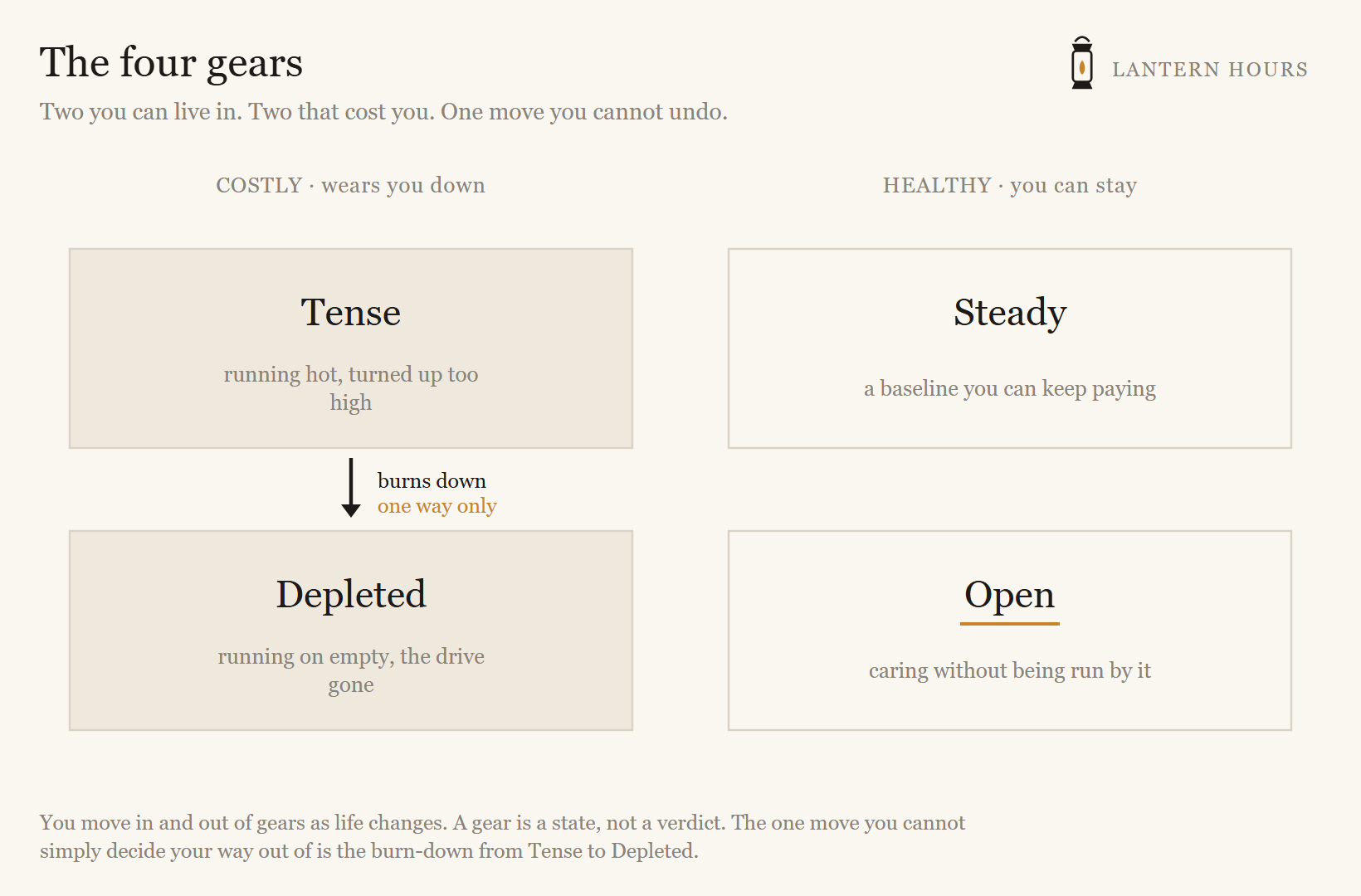
The four gears: two you can live in, two that cost you, and the one drop that only runs one way.
Tense: running hot
Running hot: on edge, restless, and hard to stop or settle.
Tense is running hot. You cannot stop pushing. Your thoughts keep jumping to what could go wrong. You cannot put anything down, even when you want to. It shows up in small, everyday ways before it shows up in big ones. You check your phone at the red light. In the shower, you are writing a reply to an email that has not even arrived yet. At 1 a.m. you are still wide awake, replaying a conversation that ended on Tuesday. The energy can feel useful, and people in this gear often get a lot done. But the body cannot keep it up. Underneath, your body is stuck in alert and will not switch off.
What it costs. A body kept on alert costs energy. You feel this directly. Sleep does not quite restore you. Your patience runs out earlier each day.
What helps, and what to watch. The thing that helps Tense is calming your body down, not trying harder. That means a lighter load, more sleep, safety, and support. It is going to bed at ten even though the list is not finished, because the list will still be there tomorrow and you will handle it better.
Tense is one of the easier gears to notice in yourself. If you cannot settle, and your thoughts keep jumping to what could go wrong, you are probably running Tense.
Depleted: running empty
Running on empty: flat and worn out, doing what you have to with no feeling behind it.
Depleted is running on empty. The drive has gone out of you, and the energy with it. You still push through the basics, but the extras fall away: the email left unanswered, the plan you cancel, the small upkeep you let slide. What you do manage you do flat and on fumes, and even that takes more than you have. Not bad, exactly. Just empty, and worn down.
The small things that used to lift the day are still there: the good coffee, the joke with a workmate, your kid’s drawing on the fridge. You still see them. They just do not reach you. You have stopped wanting things, and quietly pulled back from most of them.
People who know you say you seem off, or flat, or that they miss something about you they cannot name.
Depleted is easy to miss in yourself, because it just feels like being tired, or like this is simply how you are now. It is also the hardest gear to climb out of, because getting out takes energy, and energy is the thing you have run out of. Coming back takes time, often months, and sometimes it takes more help than you can give yourself. So if it has already been months and nothing is easing, or it keeps getting heavier, that is past what this page can do. The right next step then is a therapist or a psychiatrist, not a framework. One thing, though, does not wait for months: if it ever tips into not wanting to be here, do not sit with it alone. Tell someone you trust today, or call a crisis line or your local emergency number now.
Steady: a cost you can keep paying
Calm and steady: carrying on reliably, at a cost your body can keep paying.
What this gear is. Steady is ordinary working order. You are getting things done. A Steady week looks like this: the work gets done, you get tired in the normal way, and the tiredness clears. A night’s sleep or a quiet Sunday puts it back. There is something left in the evening. Enough to cook something you actually want, to call a friend, to be mildly interested in your own life. Not amazing. But workable.
What helps, and what to watch. When you are genuinely in Steady, there is nothing to fix. The job is to protect what keeps you here: enough sleep, real support, and a load you can actually carry. Treat that as something you keep up, not a problem you solve once.
The one thing to watch for is the tiredness no longer clearing. That is the early sign the load is starting to outrun you. The move then, if you have the room, is to lighten the load, not to push harder. This is the gear where pushing harder backfires: it only uses up the room that is keeping you steady.
The one form of Steady that is not healthy. There is a hidden version of Steady worth knowing by name: Hollow Steady. On the surface it looks exactly like real Steady. You keep doing everything, and you do it well. But underneath, the feeling and the meaning have quietly drained away. It is the hardest state on this whole map to spot, because nothing shows, not to the people around you, and often not even to you. This is the opposite of Depleted: Depleted shows, because the doing itself winds down, while Hollow Steady keeps the doing fully intact and empties out underneath. Hold it lightly, because most people who fear they have gone hollow have not. The honest check is whether the feeling comes back when the pressure truly lifts; if a real break leaves you still empty, and it has run for months, treat it the way you would treat Depleted and talk to someone. (Strictly, any gear can run hollow this way, but Steady is where it hides best and does the most harm, because it looks like the gear you are supposed to want to be in.)
Open: the good gear
Open and relaxed: you can lean in when something matters and let it go when it does not, instead of being driven by it.
What this gear is. Open is the good gear. What you care about most is still there and still moves you. It just no longer runs you, and it is no longer the whole of who you are. You can lean in when something matters and let it go when it does not. It looks like this. You still care about the work, genuinely. And you can close the laptop at seven and actually be at the dinner table, in the conversation, instead of nodding along while your mind rewrites an email. A plan you were looking forward to falls through. It lands as a real disappointment, but it does not wreck your whole week. Things matter to you, but no single one of them decides whether you are okay.
What helps, and the one thing to watch. Treat Open as something you can genuinely reach, and tell it apart from Depleted by one sign: in Open you can still be moved. Something that truly matters to you still gets a response. Flat and unbothered is Depleted. Available and able to respond is Open. Open is also the gear it is most tempting to claim, so go by that sign, not by the wish: if nothing has actually moved you lately, you are not in Open yet.
A gear, not a type
Now that you have met the four words, here is the part people get wrong most often. A gear is what you are in right now, not a type you are or a result you get once and keep.
You can check a gear again. You cannot re-check a type. The same person can run Steady this month, Tense under heavy strain, then Open once they recover. It moves, and how much it moves is different for different people.
You do not reach a gear once and stay there. Steady is what your conditions support when the load is one you can carry. Open is reachable when conditions are genuinely good. You move in and out of them as your load, sleep, safety, support, and recovery change.
The one worth knowing is the link between Tense and Depleted. Run Tense too long without relief and it can burn down into Depleted.
Knowing what gear you are in does not fix anything by itself. It just stops you from judging yourself against a gear you are not even in. The rest of this page is the deeper layer: the half of you that does not move. It is the part that explains why these particular things grab you. Read on when you want it.
The five orientations
There are five orientations: Comparison, Vigilance, Connection, Continuity, Coherence. One of them is probably yours.
Orientation is the part of you that decides what grabs your attention. A gear is where you are this month, and it moves. Your orientation takes shape early, from who you are and the home you grew up in, and it shifts slowly, over chapters of your life, not week to week.
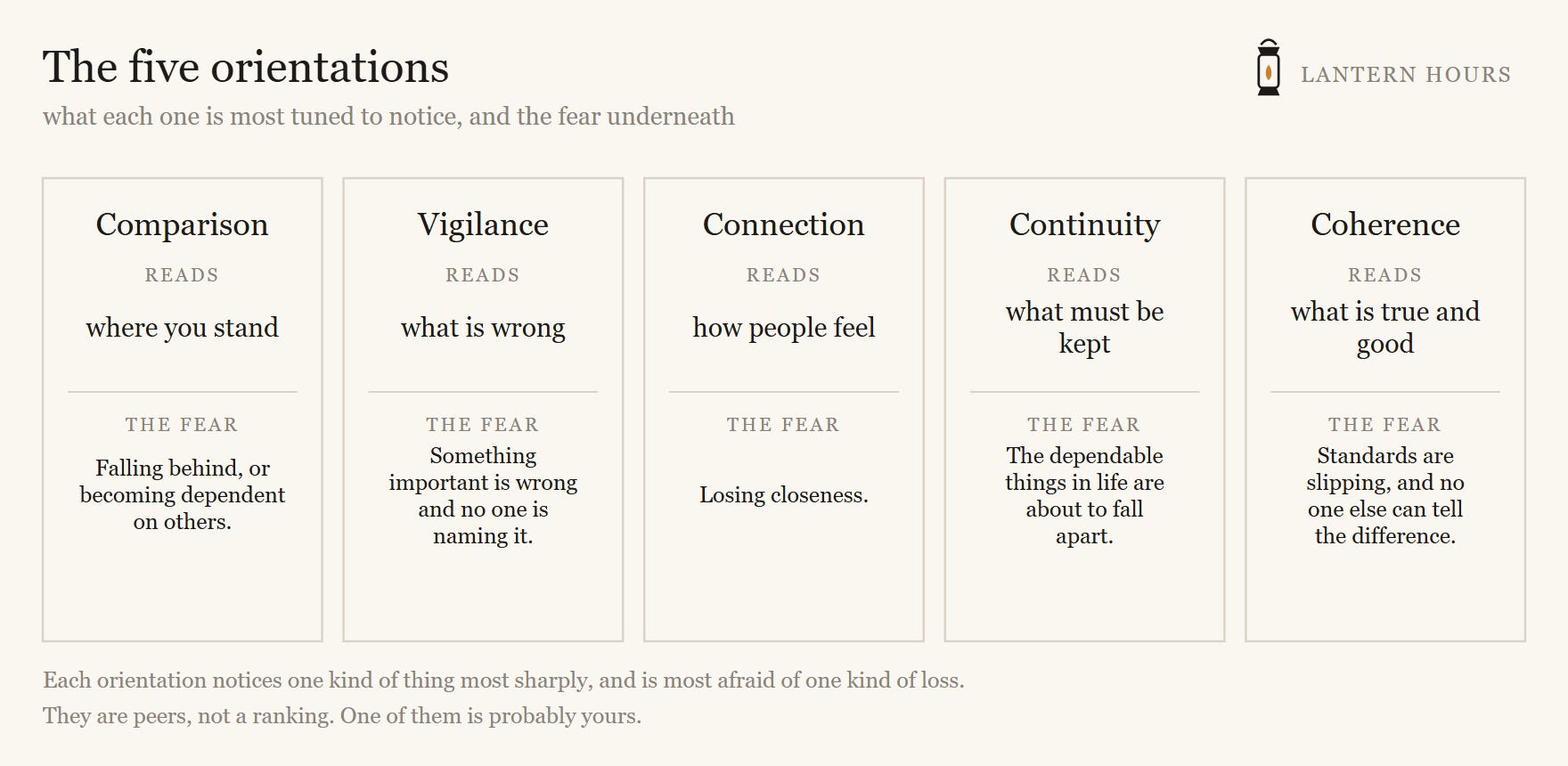
The five orientations: what each one is most tuned to notice, and the fear underneath. One of them is probably yours.
Comparison: toward the next goal
Always measures where they stand against other people, and keeps moving toward the next goal.
A friend tells you about their new job. You are genuinely happy for them. And somewhere under the happiness, a small calculation has already run: where does that leave me? You did not choose to run it. It just runs. Comparison is always measuring where you are against where you could be, and that measuring is what drives you forward. You set a target, you reach it, you set the next one. At your best, the energy is creative, you build things, and people tend to move with you.
The fear underneath it. Falling behind, or becoming dependent on others.
In the four gears.
Tense Comparison: You are pushing hard and cannot stop. You keep checking where you stand, and how okay you feel that day rises and falls with the answer. A workmate gets promoted and it ruins your afternoon, even though nothing about your own job changed. You chase wins that do not actually make your life better, because stopping feels like falling behind.
Depleted Comparison: The push is gone, but you are still stuck, or still falling behind. You catch yourself thinking, “I no longer care what anyone else is doing,” and you half believe it. The old measuring still runs in the background. You still notice who is ahead. But nothing in you wants to move toward it anymore. It is not peace. It is flatness.
Steady Comparison: You still want to get somewhere, and you are working toward it, but at a pace you can keep up month after month. You can hear about someone else’s success without it ruining your evening. Falling behind on something stings, but it does not change what you think you are worth.
Open Comparison: You move toward something when it actually matters to you, and you can sit still when sitting still is the right call. Where you stand against other people is just information now, not the thing running your day. You can want something fully and also be fine if it does not come.
That is Comparison across all four gears: you can watch the gear change how it looks while the orientation underneath stays put. The other four work the same way. Below, each gets a short description and its fear; then the table at the end lays out all five orientations gear by gear, with a link to read any one in full. You can go deeper on Comparison any time: Comparison, in every gear.
Vigilance: naming what is wrong
Spots when something is wrong that others are ignoring, and has to name it out loud.
You hear a number that does not add up, or a promise that quietly got broken, and the discomfort sits in you until you name it. You cannot let an unnamed problem pass. You care about truth and fairness, and you notice fast when something is off. At your best you are the person who speaks up when no one else will, and your willingness to say the thing makes it safe for everyone else to be honest too.
The fear underneath it. Something important is wrong and no one is naming it.
Connection: closing the distance
Senses how people are feeling and moves toward them, meeting them as an equal.
At a gathering, you notice without trying that someone near the kitchen has gone quiet, and a few minutes later you are over there talking to them, and you do not really remember deciding to go. You read how people are doing early, often before they have said anything, and you move toward them naturally. You walk into a room and you can feel the mood of it, who is at ease and who is not. At your best you make spaces where people feel understood without having to explain themselves first.
The honest cost, when you are stretched thin. You can lose track of where other people end and you begin, taking on their bad mood as if it were your own, and forgetting what you wanted before you walked in.
The fear underneath it. Losing closeness.
Continuity: holding things together
Protects what has already been built, and keeps important things from being lost.
You are the one who knows when the insurance renews, who keeps the birthday list, who makes sure the tradition actually happens this year. When a routine that holds the week together gets cancelled, it bothers you more than it seems to bother other people. You feel a quiet responsibility for the things that keep going: the regular dinner, the shared account, the friendship that would fade if no one tended it. You value what lasts over what is merely new. At your best you are the person others rely on, usually without noticing how much they do.
The fear underneath it. The dependable things in life are about to fall apart.
Coherence: the fine eye
Does what is said match what is done: has a sharp eye for real quality, can tell good work from almost-good, and wants things kept as good as they could be.
You feel the gap between good and almost-good in a way other people seem not to. Two versions of a piece of work look identical to everyone else, and you can tell which one is actually right. The typo in the final version genuinely bothers you, not because anyone will notice, but because it is there. You care about standards. At your best your eye is a gift: people trust you to say when something is genuinely excellent, because they know you would say so if it were not.
The fear underneath it. Standards are slipping, and no one else can tell the difference.
The framework at a glance
Here are all five orientations across the four gears at a glance. Comparison showed the full shape in prose above; the other four carry that same depth on their own pages. Find your row, run your eye across it, then read it in full on its own page.
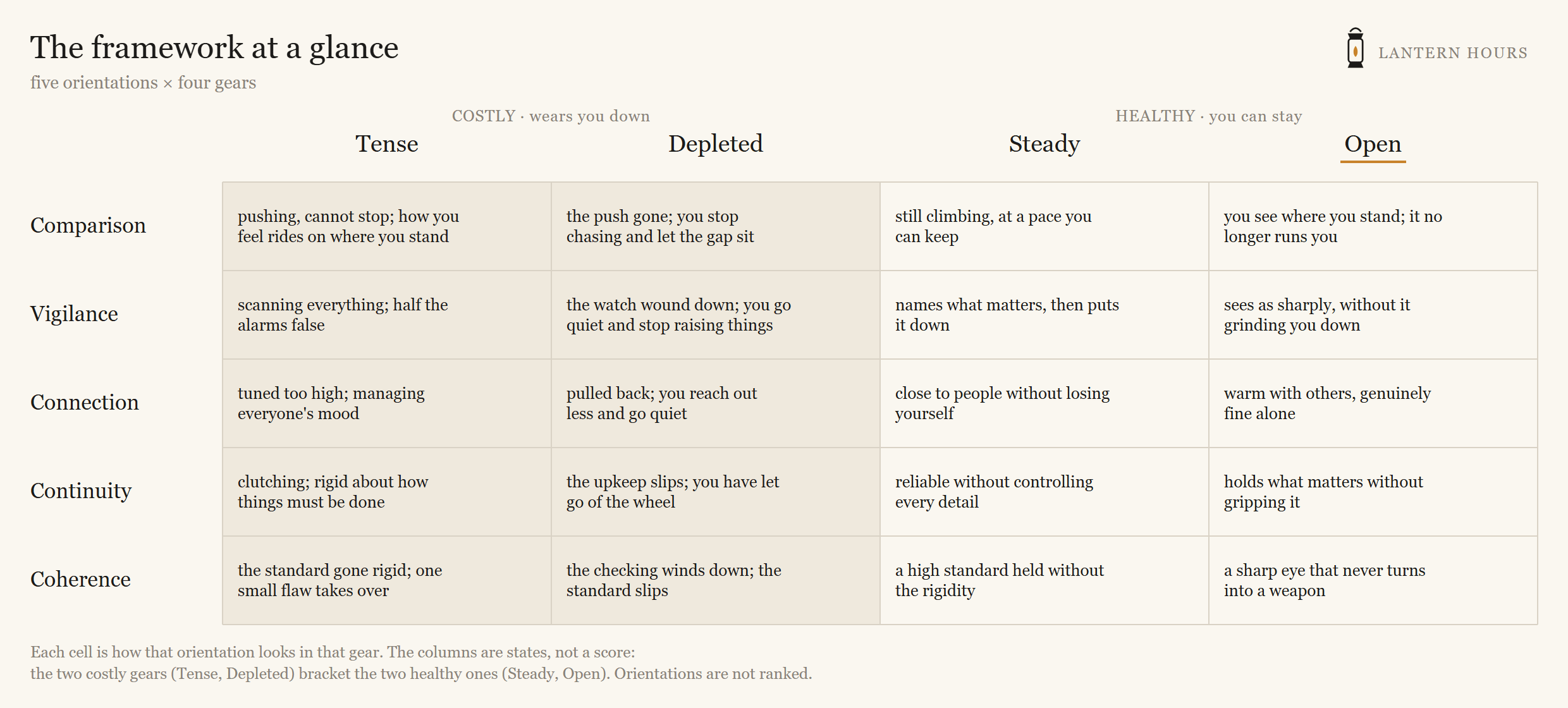
The five orientations across the four gears. Find your row and read across.
Read any one in full: Comparison · Vigilance · Connection · Continuity · Coherence.
Placing yourself
First, you are not one orientation. Everyone is a mixture, and the mixture shifts with where you are in life. You can have a primary orientation, a secondary orientation, and a few minority orientations.
Second, you always read an orientation through the gear you are in right now. Your gear moves. The orientation underneath it mostly stays.
Start with your gear, because you can read it today
The gear is the half you can read fastest, so start there. You do not need to know your orientation first. Ask yourself, about right now:
Can you settle, or are you on edge and unable to stop scanning for what might go wrong? That is toward Tense.
Are you worn down and running on empty, the drive and the energy gone, doing less than you used to and letting things slide? That is toward Depleted, which is genuinely hard to see from the inside, so an outside view helps. (If it has run for months or keeps getting heavier, see the Depleted note above: that is past this page.)
Are you carrying a load at a cost you could keep paying? That is toward Steady.
Do you still do everything, and do it well, while the feeling underneath has quietly gone? That is toward Hollow Steady, the hidden form of Steady above. It hides better than any other gear, so trust an outside view here especially.
Can you care about something when it matters, and also let it go when it does not? That is toward Open.
That is your gear for now, and it is a present-tense read, not a label you keep. The gear is the half that moves, so it is the half you will re-read most often.
That was step one: the gear you are in today. There is a slower version of the same question worth asking too: which gear, or two, have you spent most of the past twelve months in? Some people genuinely spend most of a year in a single one.
Find your orientation by the fear, not the flattering line
The orientation is harder, because the obvious way is the wrong one. Every orientation has a best-self description that sounds good, and the best-self description is exactly the one everybody wants to claim. So do not place yourself by which flattering picture you like. Place yourself by which fear you recognise from the inside. The fear is the honest tell, because it is much harder to fake to yourself what frightens you.
There are five of these orientations. Here is the fear that sits under each, with the small everyday sign that gives it away:
Comparison is afraid of falling behind, or becoming dependent on others. The sign: a friend’s promotion can quietly ruin your whole afternoon.
Vigilance is afraid that something important is wrong and no one is naming it. The sign: you are in the meeting where everyone is stepping around the obvious problem, and you genuinely cannot let it sit.
Connection is afraid of losing closeness. The sign: a short reply from a friend, and you are already turning over what you might have done.
Continuity is afraid that the dependable things in life are about to fall apart. The sign: you are the one who spots the loose stair before anyone trips, and renews the insurance a month early.
Coherence is afraid that standards are slipping, and no one else can tell the difference. The sign: you see the corner that got cut, the one nobody else even noticed, and you cannot unsee it.
Read those as fears, not as a name tag you would like to wear. Most people feel a flicker of all five, and that is normal: the honest test is which one comes back hardest, not whether the others touch you at all. The one that makes you wince is worth more than the one you would be proud to claim.
You will not turn out to be one pure thing, and you are not meant to. No single name can ever be more than half of you. That is the one firm rule.
You have probably already done the sorting, and the orientation it points to is most likely your main one. Reading those five fears, one of them landed harder than the rest, and one or two landed only faintly. That is your mix, and you found it without trying. Picture it as eight coins dropped across five jars, one jar for each orientation. Most of the coins fall in the fear you knew at once, a few in the ones you felt only a little, and none in the ones you did not feel at all. Most people’s coins land in a few jars, not one: four in Comparison, two in Vigilance, two in Coherence, for example.
One rule makes the whole thing work: no jar may hold more than four coins, so no single name can ever take more than half of you. The exact number of coins is not the point. The cap is.
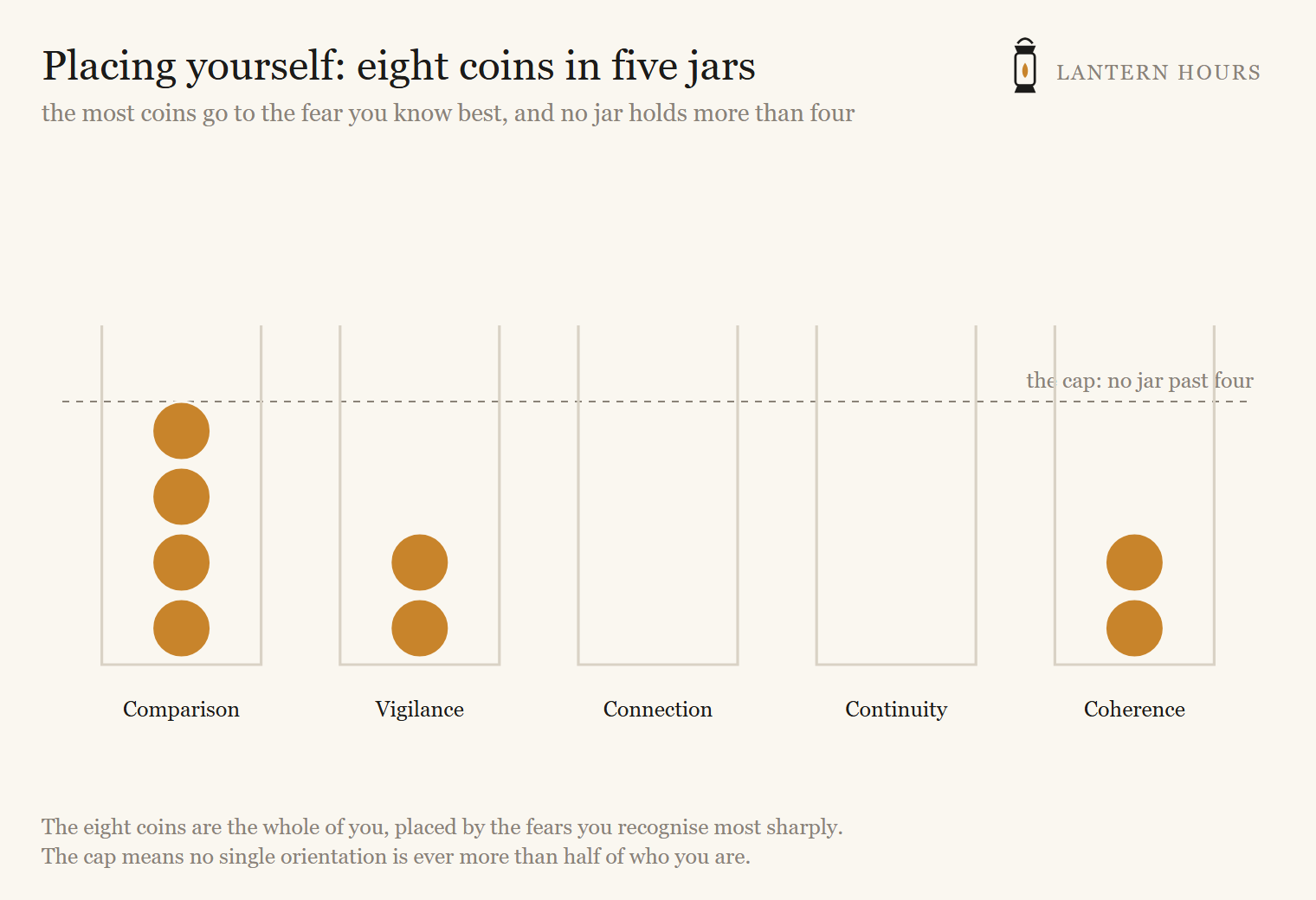
Eight coins across five jars: most go to the fear you know best, and no jar may pass four.
Your heaviest jar is your main orientation. The honest way to say it is “my main one in this window,” not “this is what I am.” You are reading the last twelve months, this chapter of your life, not something fixed at birth. Those three words, “in this window,” are the part that matters most: your main orientation is an anchor for now, not forever. Say it with those words, or you are saying it wrong.
And if no single fear stood out, or a different one stings each time you read this, that is a real answer too, not a failed test. It usually means no one orientation sits clearly at your centre right now. Read the five again in a quieter month, and see whether one settles.
How to read a pairing
Put the two words together and you get a pairing: a gear in an orientation, like “Tense Comparison” or “Depleted Continuity.”
You should say a pairing in the present tense. “Right now I’m running Depleted Continuity” is the grammar, because the gear part, Depleted, is expected to change.
You might wonder whether you could run Tense and Depleted at once. You cannot. You are only ever in one gear at a time. What you can do is move from one to another.
The pairings people misread
Once you start reading these pairings on other people, a few of them fool you from the outside. Four are worth knowing.
Depleted pairings all look alike. Worn all the way down, every orientation starts to look like the same flat person, because Depleted drains the very thing that tells them apart: the caring. So never read someone’s orientation off their worn-down surface. Read it from what they are like when they are not worn down. The surface tells you the gear, not the orientation.
Vigilance and Coherence look like the same person. Both hold things to a high standard, so from the outside both can look like someone who just wants to correct everyone. The surest tell is what the catching does for them. For Vigilance, naming what is wrong eases something the moment it is said, even if no one ever goes back and fixes it. For Coherence there is no such relief: nothing settles until the thing is actually put right. This is something you can feel in yourself; from the outside you usually cannot, so it is a tell for sorting yourself, not for placing someone else.
Open Comparison looks like a contradiction. Tracking where you stand and being relaxed about it seem not to fit in one person. They fit because Open does not switch an orientation off. It only loosens its grip.
Depleted Comparison looks like not caring. Someone stalled and seemingly fine with it is still tracking where they stand. What Depleted takes is the push, not the noticing.
Each orientation’s own page works these through gear by gear.
Reading other people, and what this cannot do
This framework reads two ways. You can turn it on yourself, where you have the inside view, and that is where it works best. You can also use it on the people around you, and that is fine. Once you have a lens like this, you start noticing it in other people anyway. You already say a friend worries too much, or an uncle is stubborn, and no one calls that a crime. “She is running Tense this month” is the same ordinary kind of read, held the same loose way.
Reading other people comes with one rule: hold the read lightly. Here is what that means, in three parts.
It is never forever, about anyone. “He is running Tense right now” is a read of this month. “He just is a Tense Vigilance” is a label stamped on for good, one the other person never chose and cannot undo. A read covers this chapter of someone’s life, the same way it covers this chapter of yours, and it can change. So say it the way you would say “he is having a rough month,” not the way you would decide once and for all who he is.
Real, lasting trouble is beyond this page. A gentle label about right now can still talk you out of seeing something serious. “He is just in the Depleted gear” is held lightly, and it can still let you wave away pain that should reach someone trained to help. If what you are seeing in someone is real and lasting, the kind that does not lift, that is not a gear. It is past what this page can do, for them just as for you. The move then is to care, or to point them toward help, not to reach for a neater label.
A read is never an answer to what someone actually said. “You only think that because you lead with Vigilance” is a way of brushing aside what a person told you, and hiding behind a label while you do it. Read the person if you like. Never use the read to dodge their point. If what they said is true, it stays true whatever gear they are in.
One last limit, and it matters as much as any of them. It is about the whole framework, not just reading others. It cannot lift a ceiling set from outside. If what is hardest in your life comes from your circumstances, no time, no money, no slack, the limited energy of a long-term illness, then naming your pattern is real, and it still will not move that. What it can offer there is recognition, and the truth that the difficulty is not a flaw in you. It will not change a limit that was set from outside you.
So here is the whole of it. Hold all of this lightly, your own patterns first and other people the same loose way. Use it for noticing, never as a box you pin on anyone, yourself included.
From here: the four gears · the five orientations · or go straight to your own orientation: Comparison · Vigilance · Connection · Continuity · Coherence.