
Where Your Mind Goes When You Stop
When you finally get to rest, the quiet does not calm you. It lets through the one thing your mind never stops watching. Which thing that is depends on how you are built.

Daniel had the evening to himself. His partner was away until Sunday. The work week was done, and for once there was nothing he had to do. He had looked forward to this all week. He made tea, sat down on the sofa, and waited for the stress of the week to fade.
It did not fade. As the room around him went quiet, his mind got louder. Not calmer. Louder. It picked up a worry and would not put it down. It went over the same worry again and again, and the stiller he sat, the worse it got.
After a while he got up. He carried his cup to the kitchen, rinsed it, wiped the counter, straightened the few things on it. For those minutes, the worry eased, almost stopped. Then he sat back down. Within a minute it was back, right where it had left off.
He knew other people lived for an evening like this. His partner could spend a whole free evening doing nothing and enjoy every minute of it. He was left with the one thing he could not explain: why does a free evening calm everyone else and wind him up instead?
The quiet was not empty
For Daniel, the quiet evening was not empty. His mind filled it with one thing. And that one thing was not random.
Most minds keep watch on one thing above all. For one person it is how they compare with others: am I keeping up, am I falling behind? For another it is safety: is something wrong, is something coming? For another it is their people: who is drifting away, who has stopped replying? For another it is their own standard: where did I fall short of the mark I hold myself to? You do not choose your one thing. You rarely even notice it, because all day the noise of doing things covers it.
Think of your mind as a house. All day, the house is loud with everything you are doing, and no single room stands out. But your mind keeps watch on one room in particular. Stop, and the house goes quiet. Now that one room is the loudest thing in it.
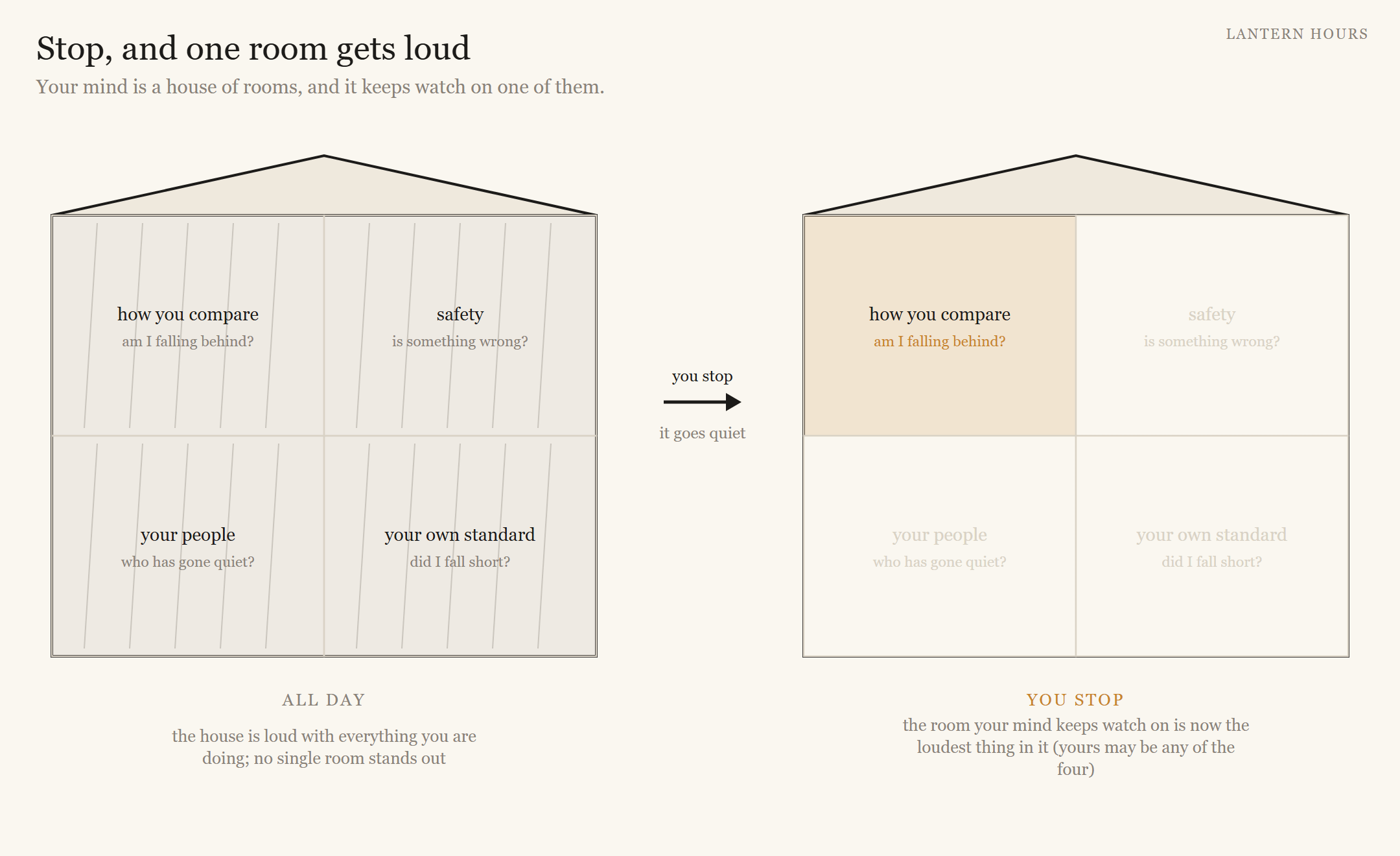
All day the house is loud and no room stands out. Stop, and the one room your mind keeps watch on is the loudest thing in it.
Look again at what helped Daniel: getting up, rinsing the cup, wiping the counter. For a few minutes the worry dropped. But it climbed back the moment he sat down. Doing something usually does not settle the room. It just puts the day’s noise back over it, for as long as the doing lasts. This is why “just keep busy” feels right and still fails. It covers the room. It does not settle what is inside.
For some people there is a second reason stopping hits so hard. If your daily work is about the very thing you watch, then being busy does two jobs at once, not one. It covers the room, and it also keeps the room calm. If your mind watches how you compare with others, working hard keeps the falling-behind feeling down, because you really are keeping up. If your mind watches your people, staying in touch keeps the bond warm. Stop, and you lose both jobs at once. If your work has nothing to do with your one thing, you lose only the cover. Either way, the room gets loud.
And here is the catch: the room never settles for good. If you watch how you compare, other people keep moving, so there is no point where you are ahead for good. If you watch for danger, the vague sense of wrongness has no list you can finish. If you watch your people, you cannot read another person’s mind, so that question stays open. If you watch your own standard, it resets the moment you meet it. Whatever your mind watches, the question opens again. Left uncovered, it runs.
So the fix is not “keep busy.” And it is not the usual one-size advice either. Rest, relax, reach out, sit with it: each of these is the right move for one room and the wrong move for the others. Which room is yours decides which advice helps you and which makes things worse. And for a few people it is not one room at all, but the whole house at once.
Which room is yours
You find your room not on a bad day but on a good, free evening. On a bad day, the loudest thing is just the bad day. On an evening when nothing is wrong and there is nothing you have to do, notice where your mind goes first.
Does it go to everyone who is ahead of you? The feeling that people your age have gone further, that you are behind?
Does it go to a wrongness you cannot point to? A feeling that something is off, or coming, with no name on it?
Does it go to one particular person? Someone who has not replied, whose silence you keep thinking about?
Does it go to your own mark? A replay of what you should have done, judged against the standard you hold yourself to?
The place your mind goes first is your room. Most people have one clear room and a fainter second one. That is normal. If everything is loud at once and you cannot pick, skip to the section on the whole house before the ending: that is its own case, with its own move. And if none of these feel like you, and your free evenings are actually fine, the ending is for you.
You only need to read your own room, plus the ending. But the other three are worth a glance. They show why the advice that works so well for someone else keeps backfiring on you.
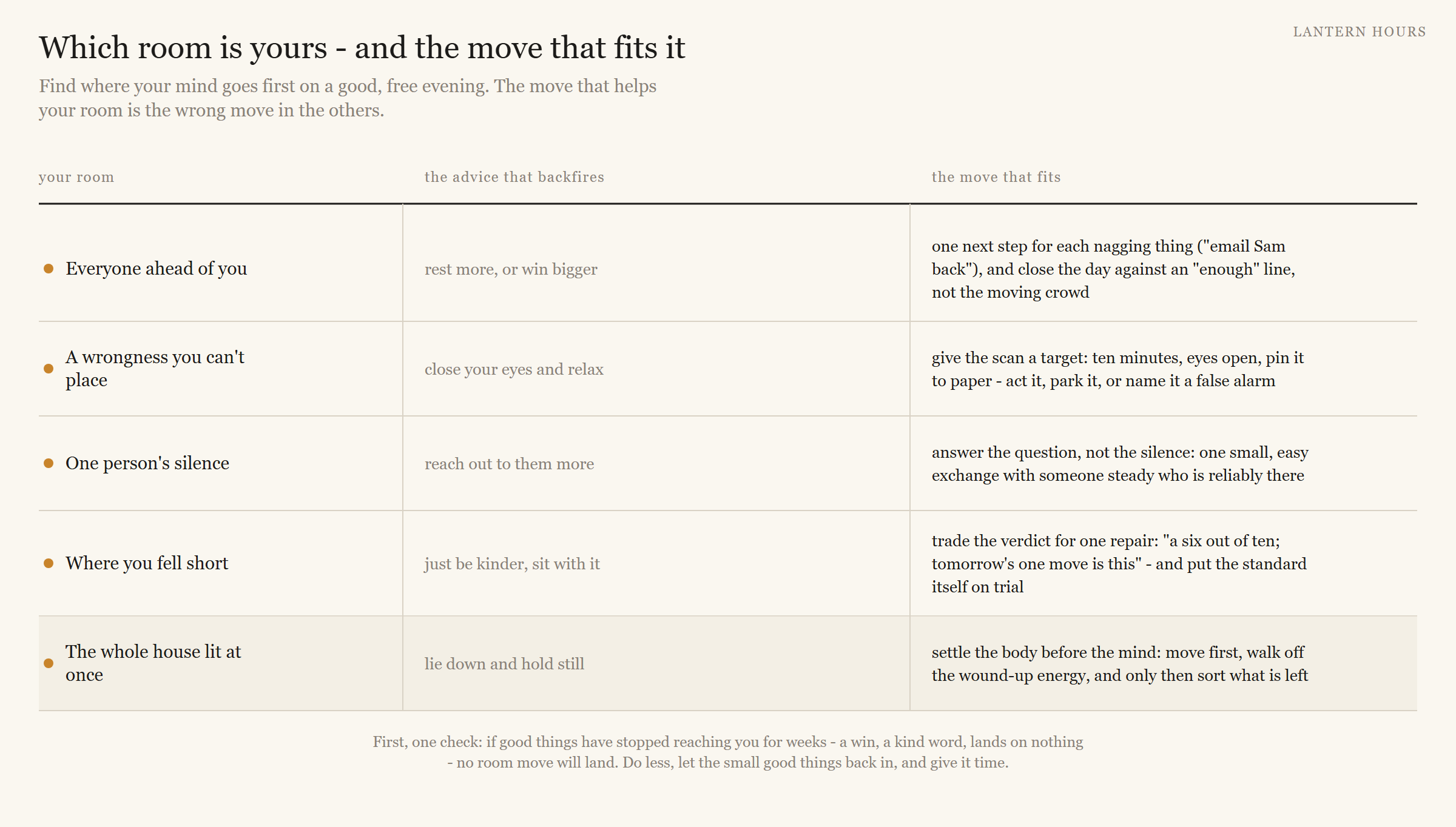
Find where your mind goes first on a good, free evening, then read your room below. The move that fits your room is the wrong move in the others.
First, one thing to check
Before any of the room moves, check one thing, because if it is you, none of them will land. When something good happens now, does it still reach you? A win, a kind word, a whole free evening: do you feel them, or do they arrive and land on nothing? If good things have stopped reaching you, and have for a while, you are not in one of the rooms below. You are running on empty, and the room moves all ask for a push you do not have. The move here is the opposite of pushing. Do less, not more. Let the small good things back in first, and give it real time. And if this has been your normal for weeks or longer, with almost nothing lifting it, that is more than a quiet evening can mend, and more than this piece is about. When the good things start to reach you again, come back and find your room. Until then, this is the only move.
If your mind fills with everyone ahead of you
Your room is comparison. Your mind fills with everyone who is ahead of you, and no win settles it for long. The sign: your mind reaches outward, to measure you against other people. Everyone your age who has gone further. The scroll through other people’s wins.
The usual advice is to rest more, or to win bigger. Both miss. If working hard was your way of keeping up, then rest removes the very thing that was holding you level, and stopping leaves you exposed. And a bigger win does not help, because by the time you reach the line, the line has moved.
The move that helps is really two small moves, because two different things are pulling at once. One is the open pile: everything unfinished stays live in your head, and stopping lets the whole pile show up together. For that, write down the single next step for each thing that is nagging you, not a plan, just the next action, like “email Sam back.” A thing with a next step attached stops shouting.
The other pull is the counter that reads “behind” no matter what you actually did today. For that, decide in advance what “enough for today” looks like, and at the end of the day close the day against that line, and against yesterday, not against the moving crowd. You do not have to work out which of the two is louder for you. Use both, and keep whichever one quiets you. Both lines work where “win bigger” cannot, for one plain reason: you can actually cross them, today, by your own effort. The crowd never stops moving, so you can never get ahead of it and stay there.
This helps most people whose room is comparison. It is not a cure, and it will not fit everyone. If you are genuinely behind on something real, like a deadline you have let slip, act on it. Do not tell yourself a kinder story instead. And if the deeper trouble is that your whole sense of being worth anything hangs on where you rank, that is a different and slower piece of work. I have written about it separately.
One more thing. This move is built for your room, not the others. Hand this fixed line to the person with the shapeless worry, and their search finds nothing to hold. Hand it to the person judging their own standard, and it lets them feel better without repairing the thing that actually needs repair.
If your mind fills with a wrongness you cannot place
Your room is safety. Your mind fills with a sense that something is wrong, and nothing you check ever clears it. The sign: a search with no target. Not one specific problem. Just a scan that never settles on anything and never stops.
The usual advice is to close your eyes and relax. Here, that is the worst move. Closed eyes give the scan free run and take away your view of the room around you, which is the very thing that could show you nothing is wrong. The alarm climbs.
The move that helps is the opposite of the comparison room’s move. Do not try to quiet the scan. Give it a target. Once, for ten minutes, pin the worry down on paper. Whatever you can act on becomes a next step. Whatever is real but not urgent gets written down and parked. Whatever turns out to be nothing gets named a false alarm. Do it with your eyes open, looking at the room you are actually in. Make it a habit: one short, fixed worry slot instead of a whole evening of drifting. A search with a finish line can stop circling. A search without one never does.
This helps most people whose room is safety. If something really is wrong and can be dealt with, deal with it: the scan is right to flag a real thing, and the list should never become a way to keep circling the one thing you could act on.
And again, the move is yours, not everyone’s. The comparison room’s fixed line would give your scan nothing to search and change nothing. And pointing your scan at a silent friend, treating a person like a threat to be cleared, is its own mistake. That room is next.
If your mind fills with one person’s silence
Your room is your people. Your mind fills with one particular person: a message not answered, a friend who seemed off, a silence you keep going back to. The sign: the worry has a name. It is about one specific person, not people in general.
The usual advice is to reach out more, and it backfires. The problem is not too little contact. The problem is what you decide the silence means. In this room, your mind asks one question: are my people still with me? Tonight it has picked that one silent person to point at, and it fills the silence with “they are drifting away,” when silence usually means nothing at all. More messages feed that story. They can also strain the very bond you are worried about.
The move that helps: answer the question, not the silence. Have one small, easy exchange with someone steady, someone who is reliably there. Even just bringing a person you trust to mind helps. A short, ordinary contact gives your mind the answer it actually wants: your people are still with you. That settles it better than chasing the one who went silent.
This helps most people whose room is your people. If a bond really is breaking down, that calls for a real conversation, not a reassuring text.
And the move that steadies you would unsettle the others. To the comparison room, one more person is one more person to measure against. To the safety room, one more reply to wait for is one more signal to read wrong.
If your mind fills with where you fell short
Your room is your own standard. Your mind replays the ways you fell short of your own mark, the same scenes on a loop. The sign points inward, not outward. It is not how you rank against others. It is what you should have done, judged by a mark that reopens the moment you meet it.
The usual advice is to be kinder to yourself and sit with it. That leaves the judgment standing. Vague kindness does not clear a specific guilt. It floats over it.
The move that helps: trade the verdict on your whole self for one concrete thing. Not “I am not good enough,” but “today was a six out of ten, and tomorrow’s one move is this.” A specific repair can clear a specific guilt. A verdict on your whole self gives you nothing to fix, so it just replays. And put the standard itself on trial: would you hold a friend to it? If not, the standard needs work, not you.
This helps most people whose room is your own standard. If you truly went against your own reasonable values, make the actual repair. Do not just relabel it. And if the charge is not “I did a bad thing” but “I am a bad person,” and going over your faults only sinks it deeper, that is a heavier thing than one evening’s move can lift. It is not a failing, and it is worth more care than this piece can give it.
This move, too, belongs to its room. Aimed at the comparison room, it puts a standard on trial when the real trouble is a line that keeps moving. Aimed at the safety room, it turns an outward scan onto the self and sharpens it.
When the whole house is lit at once
Sometimes it is not one room. Everything is stirred up together, every room loud and lit at once, refusing to sort into any single thing. This is the reader who could not pick from the list. It is not a fifth kind of watch. It is your body wound up and running high, and the room moves fail here because there is no single thing to take hold of.
There is a sign for this state. Notice that the same wound-up feeling lands on a different worry each night: money on Monday, a friend on Tuesday, your health on Wednesday. If the feeling is constant but the subject keeps changing, that is the sign. The body is supplying the alarm; the room is only supplying tonight’s story for it. It feels like four different problems. It is one revved-up body wearing four different faces.
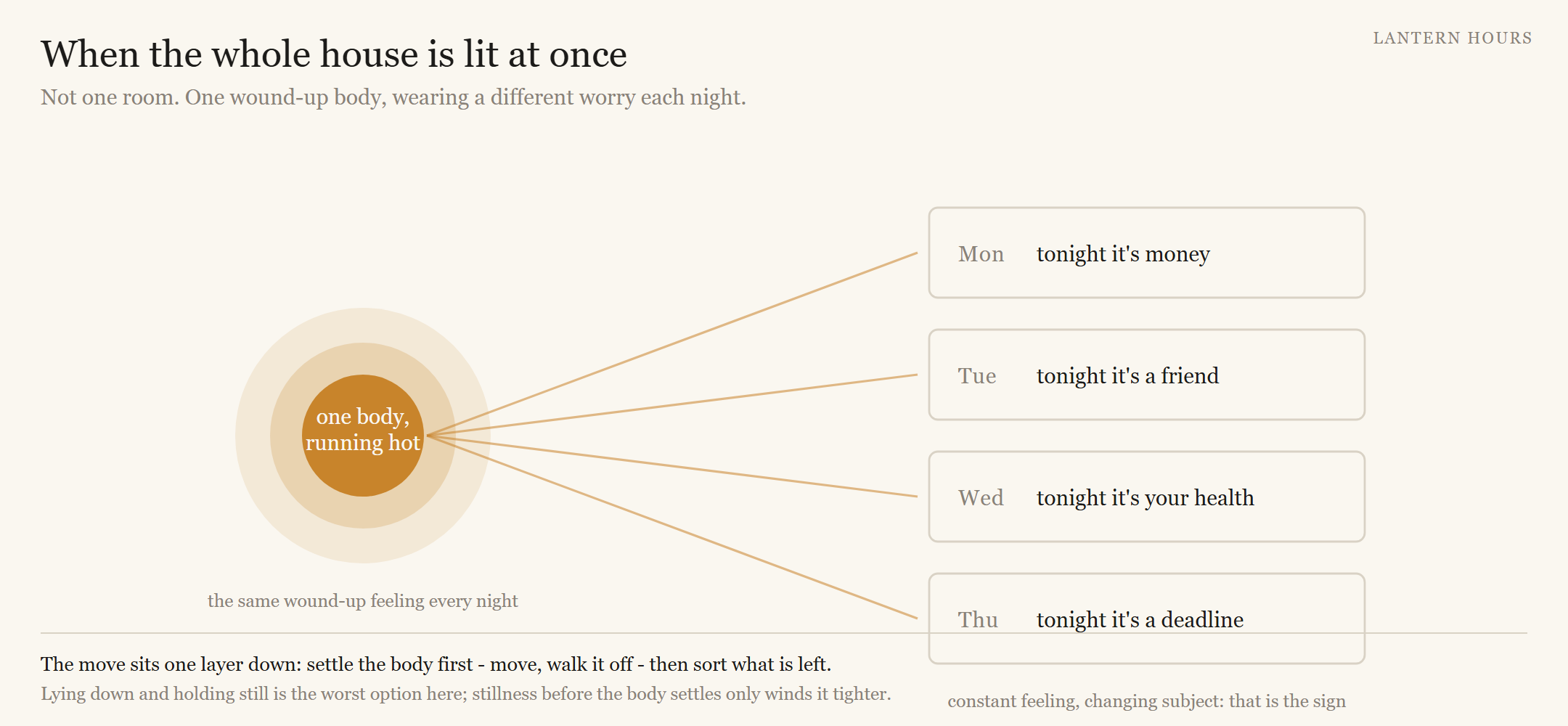
One wound-up body, wearing a different worry each night. Constant feeling, changing subject: settle the body before the mind.
The move sits one layer down: settle the body before the mind. Move first. A walk, anything that burns off the wound-up energy. Only then try to sort what is left into the rooms above. Lying down and holding still is the worst option here. Stillness before the body settles only winds it tighter.
This helps most people whose body is running hot. And if you are wound up like this most days, not just tonight, check the plain physical things first: sleep, caffeine, a day with no movement in it.
The quiet was never empty
The quiet was never empty for Daniel, and it is not empty for you. What fills it is the one room you cannot stop half-listening to, now loud enough to hear.
Knowing your room does not switch the watch off. You will keep watching your one thing. That wiring does not change. The work is only to turn the volume down. You do it with the move that fits your room: a fixed line, or a target, or one steady person, or one next step. Or, when the whole house is loud at once, by settling the body first.
And this is not everyone. If none of the rooms felt like yours, that is real, not a failure to look harder. The person who can spend a free evening doing nothing, and enjoy it, is not stronger than you. Some houses are simply quieter: a lighter watch, a shorter list, a rest that was always safe.
Nobody should tell you the quiet will one day feel like nothing. It will not. What changes is smaller and better than that: the quiet stops feeling like an ambush, and starts feeling like something you can sit inside. That is the honest version of the evening you were reaching for.
From here: The four rooms are the everyday face of something more structured. In the framework behind this piece they are called orientations, the settled styles of watching that a mind runs on: Comparison, Vigilance, Connection, and Coherence, with the wound-up whole-house state cutting across all of them.
How sure is this? That the mind keeps an always-on watch, and that stopping uncovers it, is well established. That the watch sorts into these four rooms, and that each room needs its own matched move, is the lens this piece chooses: a good account you can test on yourself, not a settled fact. The picture of a wound-up body borrowing tonight’s worry is reasoned from how the pattern works, not proven; treat it as worth trying, not as law. No one can tell you which room is yours from the outside. It is yours to check, on the next good, free evening.